

2025: The Year That Was
Wrapping up the year with some "best of"s

If it’s the last working Friday in December, it’s your last Family Matters of 2025:
The Top Ten List: The year’s best, or at least most fun, works of arts and letters
Family Matters’ Greatest Hits: The ten most-read posts of 2025
It’s Me, Hi: The Dispatch, Civitas Outlook, Heritage Foundation, NOTUS
Parting Shots
The Top Ten List
It is becoming somewhat of a Family Matters tradition (three years running now, including our previous installment as a Mailchimp product,) to end the year with a list of the top ten cultural products that I found especially noteworthy or memorable. It’s an unholy algorithm of stuff I liked, stuff that captured the year’s zeitgeist, and stuff I’d recommend if I knew nothing about your tastes and wanted to maximize your probability of a good time (you can find your “homework” Best Of lists elsewhere.)
This year I was more of a stickler on sticking to things with a publication or release date of 2025, which meant leaving some late entrants from last year off the list. As always, if you want a sporadically-updated “real”-time thread, join me on Letterboxd (unironically my favorite social media network) or Goodreads.
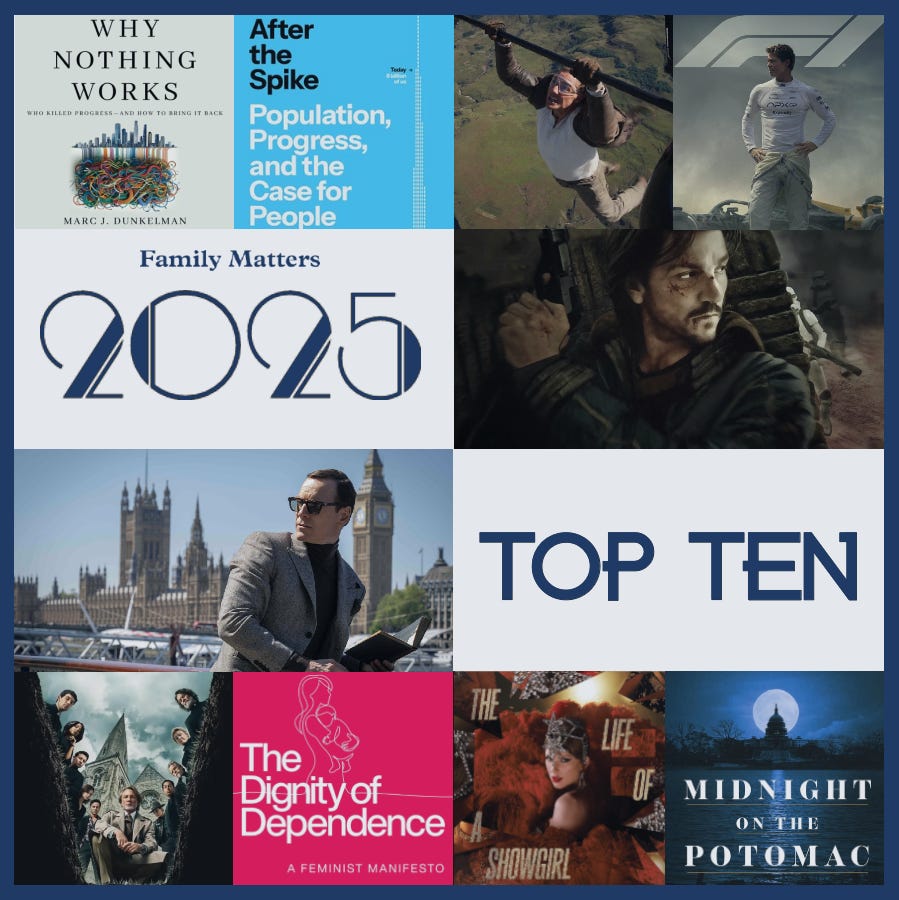
10.) “Midnight on the Potomac: The Last Year of the Civil War, the Lincoln Assassination, and the Rebirth of America,” Scott Ellsworth
Hard-core history buffs might scoff at yet another book covering the baleful events at Ford’s Theatre on April 14, 1865, but Ellsworth’s book does an enjoyable job putting Booth’s life and career in context (he lays out a fairly convincing case on the side that Booth was closely linked to Confederate spies, whether or not there was a direct order.) We can sometimes fast-forward from Gettysburg to Appomattox Courthouse, but Ellsworth drives home the sense of contingency — the Confederate Army stopping just short of D.C., the Union Army making overdue leadership changes, Lincoln avoiding an earlier assassination through sheer luck. You’ve heard much of it before, but a skilled writer can help you see it all through new eyes, and that’s what “Midnight on the Potomac” does.
9.) “The Life of a Showgirl,” Taylor Swift
I think it’s fair to call “Showgirl” Swift’s most polarizing album to date — the heights of the album’s opening three (“The Fate of Ophelia,” “Elizabeth Taylor”, and “Opalite”) are almost outweighed by the variability of the back half of the album. The “showgirl” motif remains an odd fit for an album that is, as Alyssa Rosenberg wrote for NOTUS, an aggressive “ode to normalcy,” picturing kids, a driveway with a basketball hoop, and a romantic relationship that leaves her satisfied on any number of dimensions. But the album’s record-breaking performance suggests an audience excited to share in Swift’s pre-marriage enthusiasm, and if you can’t be happy for her or find yourself bopping along to the first three tracks in particular, you’re just a killjoy.
8.) “The Dignity of Dependence,” Leah Libresco Sargeant
Previously reviewed in Family Matters, Sargeant’s book has become more unsettling and more necessary in the months since release. It’s a manifesto, not a playbook, and as long as you approach it in that spirit, you’ll find real richness. As I wrote in September: “Like Hadestown’s Orpheus, she sees ‘the way the world could be, in spite of the way that it is.’ No one engaging with Sargeant’s book will find themselves agreeing with every single example or thought experiment – but they will not run out of ideas or provocations with which to grapple.” (Due to a tie at number six, we skip number seven, like a professional golf tournament, and go straight to)
6.) F1 (dir. Joseph Kosinski) / Mission Impossible: The Final Reckoning (dir. Christopher McQuarrie) [TIE]
These movies end up in a tie because they are, in essence, the same — older movie star [Brad Pitt / Tom Cruise] shows up to grin wryly, put on a [race car / scuba diving] helmet, face down an existential threat [bloodthirsty investors / bloodthirsty AI] and legitimately risk death to show us something we’ve never seen before. They also highlight, in an incredibly effective way, what we will miss when the movies are gone. No AI actress, no battle of CGI-created lasers and lightning bolts while actors react to tennis balls against a green screen, are ever going to be the equivalent of physically strapping into a race car going 200 miles per hour or dangling from a biplane. Both are very fun, and both offer surges of adrenaline fit for pre-teens and up (even I got a little antsy during Cruise’s extended underwater sequence.) The final (?) M:I film in particular is a little long, F1’s plot a little hackneyed. But beyond the plot twists, acrobatics, and showmanship, both movies’ themes and meta-narratives offer a welcome antidote to AI slop — the main characters, and the stars who portray them, responding to the threat of obsolescence by knowing what only you can do, and doing it excellently. Might be uncomfortably relevant uncomfortably soon!
5.) Black Bag (dir. Steven Soderbergh)
There are some people who are Soderbergh aficionados, and I’m not one of them. But his chilly, analytical style lets the cat-and-mouse drama, and electric performances from Michael Fassbender and Cate Blanchett, shine. Black Bag is a modern-day John le Carré novel with some psychodrama layered in, absolutely stunning set design and cinematography, and clocks in at a blessedly tidy 94 minutes. Never didactic or heavy-handed, it explores secrets, intimacy, trust, and commitment and looks good doing it. In both subject matter and style it’s decidedly for adults, but if that’s your speed, you won’t regret it — sleek, sexy, and surprisingly pro-marriage!1
4.) “After the Spike: Population, Progress, and the Case for People,” Dean Spears and Michael Geruso
“The year 2012 may well turn out to be the year in which the most humans were ever born—ever as in ever for as long as humanity exists.” With that, economists Spears and Geruso start their book, one of the most cogent respectable cases for pro-family policies aimed at bolstering birth rates on offer (the socially disreputable case, of course, can be found every week in the pages of Family Matters!) Conservatives are more inclined to see declining birth rates as a problem, and thus need this book less, but if you have a well-meaning centrist in your life who needs to be convinced to start caring about a world of declining population growth, “After the Spike” needs to be in their stocking (it will almost certainly convince very few to boost their own personal fertility rate, but that problem would require a different book or five.) Readable, honest, and persuasive, Spears and Geruso have produced a book that deserves to be taken seriously; particularly by anyone working on sensible centrist policymaking.2
3.) Wake Up Dead Man: A Knives Out Mystery (dir. Rian Johnson)
Admittedly a beneficiary of some recency bias, as this recently hit Netflix just in time for some cozy holiday watching (not with kids, given some extremely graphic confessional talk early on.) But that notwithstanding, Daniel Craig’s turn as Benoit Blanc — amusing the first go-round, didactic the second — uncovers new territory in his investigation of the murder of an older fire-and-brimstone priest. Josh O’Connor, as a younger priest, Father Jud Duplenticy (what a name), offers what might be the most compelling and empathetic performance of a member of the clergy in any mainstream film this century, and a last-act confession is one of the most moving depictions of the sacrament since, I don’t know, at least “I Confess.” It’s rare to see a film take redemption seriously — rarer still to give silver-screen treatment to surprisingly deep discussions about storytelling, tradition, and belief. It’s a contemporary meeting between Hercule Poirot and Father Brown — no wonder the Catholics in your life are all going to love this, and you very likely will too.
2.) “Why Nothing Works: Who Killed Progress—and How to Bring It Back,” Marc J. Dunkelman
Ezra Klein and Derek Thompson’s “Abundance” got the headlines, made the best-seller lists, and certainly captured the imaginations of Democrats looking for an attractive futurist vision post-2024. But pound-for-pound (or at least per capita) my favorite book from the left on the stagnation of our current socio-political moment was “Why Nothing Works,” a review of the decisions made in the 20th century to deprioritize growth and dynamism in favor of the status quo — and why that has made life more frustrating and more expensive in the 21st. At times, it feels like Dunkelman is stuck talking to two different camps on the left (the “Jeffersonians” and the “Hamiltonians” are pitted as antagonists to conservative revanchism, but it’s not clear that he wouldn’t have better lucky ditching the environmentalists and making alliances with the technocratic center-right.) Because the left has taken to fetishizing proceduralism over Robert Moses-ism, he argues, “progressivism [has become], in short, a movement of do-gooders unable to do enough good.” It’s an incredibly useful way of looking at the trajectory of domestic policy over the past century, on everything from welfare policy to energy production, with lessons for everyone from “Abundance”-philes to conservative (or neo-conservative) urbanists.
1.) Andor [Season 2] (creator: Tony Gilroy)
There’s little more than can be said about the heights Andor reached in either of its two seasons. There’s no reason Gilroy and the Disney crew had to go so hard in creating the most lived-in Star Wars settings, and realistic heroes and villains, especially relative to the rest of the streamer’s relatively disappointing Star Wars series offerings. And there’s little I can say to convince you to watch it — if you’re a Star Wars fan, you already have, and if you’re not, you will write it off. But it remains the most evocative and powerful work of popular art from 2025, matching, and maybe even surpassing, the highs of season one with its arcs about doomed resistance fighters, sacrifice, and what it means to sign up for a battle whose end you know you will not live to see. (I particularly enjoyed the discussion of its themes by Matthew Continetti and John Podhoretz on the Commentary podcast earlier this year.)3 The resistance here isn’t glamorous — it’s full of sacrifice, ordinary people doing extraordinary things with uncertain payoffs (Stellan Skarsgård as the art-and-arms dealer Luthen Rael deserves a place in TV’s Hall of Antiheroes (or “Heroes?”)) There are plenty of contemporary political glosses one can read into Andor, if one chooses, but even without that, it’s more than just the best Star Wars streaming product, it’s everything you could ask from a long-form prestige TV series.
Greatest Hits
Here at Family Matters, we don’t believe that markets are the ultimate measure of value — plenty of things go viral that shouldn’t, and much that doesn’t go viral should (at least, sometimes.) But metrics measure what they measure, and until engineers come up with a chip that can measure how much a given post changed your life (or at least marginally contributed to your assessment over a given policy change), all we can report on is what you, the people, found worthy of bestowing a click upon over the past year. Without further ado, we bring you Family Matters 10 Most Popular Posts of 2025:
10.) Woke, Broke, or Boring? Pixar’s crisis of ‘identity’
9.) How Not to Improve Child Care
8.) By the Beautiful Blue Danube
7.) Mars Ain’t the Kind of Place to Raise Your Kids
6.) It’s Time for the White House’s Family Policy Pivot
5.) Needed: A White House Summit on Family and Fertility
3.) A Reconciliation Kids Menu
2.) How to Make Society More Pro-Family By Really Trying (honorable mention considering it got to the number two spot after only having two weeks to rack up the numbers)
and coming in at number one, our most-read Family Matters installment of 2025, is “Those Things Money Can’t Buy,” our look at some new work on what universal basic income has been promised to be able to do — and what it actually does. Thanks to all for reading!
It’s Me, Hi

For The Dispatch, I wrote about the recent spate of horror stories from the industry of commercial surrogacy, and what they illustrate about the hollowness of a mindset that seeks only to maximize reproductive autonomy:
If the only criterion by which we can judge an action is whether this individual or couple wants a baby or not, then all sorts of uncomfortable moral and ethical doors must remain open—more forced abortions for breach of contract, more tech tycoons using surrogates to produce a “legion” of genetically-optimized children, more cases in which children conceived via the same sperm donor unknowingly inherit genetic mutations, and more. If, instead, we can admit that justice for both the surrogates and the babies they carry demands something more than mere acquiescence toward the demands of the market, we could envision meaningful reforms.
I was happy to participate in a symptom at the University of Texas at Austin’s Civitas Institute on the right relationship between federal and state government and support for families.
A more pro-family society will require more attentiveness to the economic pressures on families, as well as the pain points that make raising a child more difficult, be it the pressures of social media, wasted hours in traffic, or crime and disorder. The federal government can, and should, make some of the financial trade-offs somewhat less painful. But when it comes to daily life, states can – and should – experiment with different approaches to centering families’ needs in public policy.
Other participants included W. Bradford Wilcox, Catherine Ruth Pakaluk, and John Shelton and Joel Griffith — their contributions here.
I contributed to a new report from the Heritage Foundation, arguing that the promise of polygenic embryo screening is oversold and the negative impact on our culture and society underrated:
“[This technology] has moved far beyond its medical origins. What began as a tool to detect rare disorders now functions as a commercial system that classifies, ranks, and eliminates human embryos. Polygenic risk scores, whole genome sequencing, and AI-assisted selection promise precision and control but instead create a false sense of mastery over life. These technologies cannot heal; they only decide which lives are allowed to continue. In doing so, they risk transforming the creation of human life into a marketplace of options and outcomes.”
I spoke to Emily Kennard and team at NOTUS on the political fault lines underlying the White House’s deliberations on marijuana legalization:
This is an example of where the maybe populist strain in the Trump coalition is at odds with the more traditional conservative, social conservative, religious conservative, whatever you call it, part of the party,” Patrick T. Brown, a fellow at the Ethics and Public Policy Center, told us. He’s not a fan of weed’s effects on “young men’s labor force participation and marriageability, to put it bluntly.”
Parting Shots
Megan McArdle writes a deeply personal, incredibly powerful essay on what conversations with her mother towards the end of her life revealed — difficult to recommend it any higher without spoiling it (The Dispatch)
Mary Julia Koch helps launch the new Wall Street Journal “Free Expression” product with a piece ably summing up the current “online battlefield” that is contemporary dating culture, including insightful quotes from my EPPC colleague Erika Bachiochi
Stephanie H. Murray examines the impact of commuting and finds plenty of reason to find it bad, partiuclarly for moms — yet more reason for pro-sprawl conservatives to temper their enthusaism (The Atlantic)
EPPC’s Ryan Anderson and Jamie Bryan Hall argue that the Trump administration should rescind the Covid-era expansions of abortion pill prescriptions (The Federalist)
New York Governor Kathy Hochul signed the state’s new assisted-dying law, which will eventually, likely inevitably, leave more seniors feeling more pressure to hasten their final years
American Principles Project’s Terry Schilling co-authors a piece with Brian Robertson about how Republicans need to prioritize family affordability before the midterms — they’re right (The Hill)
I enjoyed Robert VerBruggen’s careful but not overly credulous review of Corrine Low’s “Having It All” (Family Studies)
Despite Mayor Michelle Wu’s high-profile efforts to help subsidize the cost of raising children, families continue to leave Boston (The Boston Globe)
Olga Khazan covers the surprisingly direct link between child care affordability and immigration enforcement (The Atlantic)
Lakshya Jain with some intriguing polling on parenting and education for The Argument, suggesting that Democrats have yet to regain their long-time polling edge on education, partly due (perhaps) to Covid and its aftermath:

Comments and criticism both welcome, albeit not quite equally; send me a postcard, drop me a line, and then sign up for more content and analysis from EPPC scholars.
As one Twitter wag put it, this case for non-ethical monogamy is far more watchable and intriguing than any of the available cases for ethical non-monogamy.
While they put their cards on the tables about their values in a way that may rub some conservative readers the wrong way, I took that as a sign of them wanting to admit to their perspective rather try to smuggle it in, which any reader should appreciate. And their scholarship is down-the-line, such as when they devote part of a latter chapter to walking through why subsidies for IVF will not actually solve our birth rate problems, despite the cheerleading of various online commenters.
Diehards may enjoy the “Interesting Times” conversation between show runner Gilroy and Ross Douthat, though others may find Gilroy’s casual partisanship to betray his professed disinterest in having his show read politically.