

Just Deserts
Friends shouldn't let friends cite a common statistic about unmet child care need

Jordy Frahm, who plays softball for the Nebraska Cornhuskers, hit .403 this season, with a 1.302 OPS, 20 HR, and 51 RBI at the plate, and pitched a 1.37 ERA with 251 Ks and 21 wins. Plus — she did it all while pregnant (due in December, mazel tov!) Let’s see Shohei Ohtani do that. If it’s Friday, it’s Family Matters:
Child Care Deserts Are Not What You Think They Are: Viral claims about lack of supply don’t account for lack of demand
Work Requirement Watch: A ticking political time bomb
It’s Me, Hi: Webinar on Magnifica Humanitas, The Lion, The 74
Parting Shots
Child Care Deserts Are Not What You Think They Are
American legislators are fond of saying our child care system is in a perpetual state of crisis. Last year, Senator Jacky Rosen (D-Nev.) responded to a report calling the state of Nevada a “child care desert” by introducing a bill that would subsidize the “soaring costs of child care.” Senator Kirsten Gillibrand (D-N.Y.) cited a study that found that two-thirds of children in New York state “lived in a child care desert” when introducing her bill to expand workforce development grants for early childhood workers. And HR 1443, a “sense of the House” resolution introduced in 2024 by Rep. Suzanne Bonamici (D-Ore.), would have had Congress officially declare that “more than 50 percent of families in the United States live in child care deserts.”1
The concept of a “child care desert” was popularized in 2016 by Child Care Aware of America and the Center for American Progress. In “introducing a working definition of child care deserts,” CAP said, it was borrowing “its terminology from the frequently studied problem of food deserts,” the idea that parts of the country lacked access to fresh fruit and vegetables, and other healthy foods. Child Care Aware said it was introducing the concept to highlight that “the identification of deserts is important, because it identifies an absence of an essential commodity that results in limited access.”
But food deserts, as it turns out, are basically fake. Or, if you prefer a more “nuanced” view, the very concept of “food deserts” themselves have come under fire for representing a misunderstanding of the dynamics of healthy food access (see SIDEBAR: Food deserts are basically fake, below). And the idea of a “child care desert” itself may obscure at least as much as it clarifies when it comes to building an early childhood system that meets parents’ desires and needs.

Let’s unpack the way the most commonly-cited method of identifying a “child care desert” is constructed. According to CAP’s definition, “a family is considered to live in a child care desert if they reside in a location with more than three local young children, under age 6, per local licensed child care slot.” In other words, if the following equation is true for a given area, you have a certified Child Care Desert™:
Surely you can see the problem?
The first objection is raised by child care advocates who dislike the denominator’s focus on licensed child care. As a brief published by the National Women’s Law Center argues, “the phrase ‘child care desert’…obscures and further stigmatizes the existence of Family, Friend, and Neighbor (FFN) Care.” For its part, CAP’s most recent “desert” report does state that FFN “providers are an important part of the care ecosystem...[yet] are unlicensed and frequently unregistered with the state, [and] there are no standardized data on where each such provider is located nor how many children they serve. Therefore, while child care deserts are a useful measure of supply and access, they do not provide a comprehensive picture of the child care arrangements families use.” That important caveat tends to get lost when the “desert” terminology starts getting thrown about.
But the broader conceptual flaw is thinking a little harder about the numerator. 45 percent of kids age 5 and under are not involved in regular child care, per the 2023 Early Childhood Program Participation survey. An area with a higher-than-average birth rates, or with a high share of moms at home — think Provo, Cheyenne, and Billings — is going to mechanically show up as a “child care desert” despite the fact that these families may not be actually seeking out child care (and some wouldn’t regardless of the level of subsidy.)
In other words, the most popular measure of “child care deserts” plausibly overestimates the desire for care and certainly underestimates the supply of child care options. It counts every young child as contributing to “unmet demand,” regardless of whether parents actually want a licensed slot. Citing it uncritically should be a sign that you are looking to score rhetorical points, rather than actually understand and solve access problems.
There is a different method of calculating the “child care gap” that looks at just the delta between the number of licensed child care providers and the number of children with all available parents in the labor force. This metric, supported by the Buffett Early Childhood Institute at the University of Nebraska, finds that 28 percent of children do not have access to child care within a “reasonable distance.” That’s probably a safer ballpark estimate than the idea that half of American children live in a child care “desert.” But it rests on the assumption that the ratio between slots and kids reflects some relationship between the demand for professional child care and the underlying characteristics of the region.
The more interesting question we can ask is whether a “desert” reflects an area where people are seeking professional licensed child care and not finding it, or if it, instead, identifies areas without a lot of child care demand.
The answer is obviously “some of both,” but a new paper from a leading child care researcher can help us make some better sense of the facts on the ground so you can “well, actually” your friends the next time someone naïvely cites the “more than half of American children live in a child care desert” line.
At this point, we need to make a disclaimer — what follows are my views, not those of the paper’s author. Any questions of interpretation, extrapolations beyond what the text of the paper says, or normative claims about how policymakers should apply this paper’s findings to their work should be attributed to me and me alone, and the author of the paper has not reviewed, and would not necessarily endorse, the way this newsletter characterizes the paper’s findings. All opinions and errors are mine alone and should not be considered the intellectual equivalent of community property.
IZA Working Paper No. 18597 uses vacancy rates at child care providers to proxy for the underlying demand in a given area. After all, if providers are facing wait lists out the door, families can be presumed to be looking for child care and having a hard time finding it.
The problem, the working paper finds, is that being labeled as a “child care desert” is “only weakly correlated with low vacancy rates,” suggesting that, as you might expect, the areas identified as “deserts” are not necessarily the ones with unmet demand. Accounting for demographics, the “child care desert” approach does not actually correlate with the observed provider vacancy rates outside of one-year-olds. Thus, the author writes, “targeting funds based on this measure (as some states did with American Rescue Plan Act dollars) could lead to misallocation.”
The IZA paper, however, takes a different approach than counting slots and kids, accounting for demographic characteristics like religiosity, education, urbanity, race/ethnicity, and family structure to produce a predicted number of licensed child care slots in each county. “Parents differ in their demand for care,” the author notes, “and what may be an inadequate level of care in one area may be sufficient to meet demand in another area.”
Accounting for this allows for a more fine-grained approach to evaluating where is — and is not — an actual “child care desert.” More importantly, that insight should help inform a more nuanced conversation about parents’ preferences than simply relying on a mechanical approach that paints misleading pictures about the extent to which parents want and can’t find licensed child care.
SIDEBAR: Food deserts are basically fake
As a well-informed, highly savvy reader of Family Matters, you probably already know this, but on the off chance you’ve missed it with everything else going on in the world…For a long time, anti-poverty and anti-hunger advocates would blame high rates of obesity and food insecurity on “food deserts” — places where residents did not have access to healthy, affordable food. Progressives were traditionally quick to blame corporations or capitalism for “supermarket redlining,” or not investing in grocery stores in low-income areas and preventing food desert residents from being able to buy fruits and vegetables, instead forcing them to rely on ultra-processed foods or high-sodium snacks.
It’s not that observers are wrong to note the lack of grocery stores in inner-city and low-income neighborhoods. It’s that attributing that to supply-side, rather than demand-side, factors gets the equation wrong. In 2019, a team of researchers (Allcott, et al.) published a paper in the Quarterly Journal of Economics finding that “food deserts” are largely a function of household preferences in those areas, and that “exposing low-income households to the same products and prices available to high-income households reduces nutritional inequality by only nine percent” (working paper version here.) They measure this three ways; by looking at the exogenous entry of new supermarkets into neighborhoods, household moves to new neighborhoods, and cross-household purchasing patterns (different people in the same household with the same level of access to local food retailers).
Across all these measurements, they find almost no evidence to suggest that it is lack of access to healthy food that is driving poor nutritional outcomes; rather, it is “differences in demand” across income levels. Their findings suggest that higher-income households have stronger preferences for healthy foods2, and that educational attainment is one of the strongest predictors of being willing to pay more for fresher, healthier foods. They also point out that the very notion of a “food desert” is partially misleading because it ignores the degree to which nearly all Americans travel some distance (median travel time to grocery store: 10 minutes) to purchase their groceries. In sum, they suggest, “supply-side policy initiatives aimed at eliminating food deserts will have limited effects on healthy eating in disadvantaged neighborhoods.”
Work Requirement Watch
Seven months ahead of the end-of-year deadline, CMS has issued its interim rule for implementing work requirements for adults on Medicaid. States now have to ensure non-pregnant adults age 19 to 64 are working at least 80 hours per month to receive Medicaid benefits. They can meet the requirement by working, participating in community services, enrolling in education on at least a half-time basis, or earning an income of at least $580 a month. Exemptions include American Indians, Alaska Natives, disabled veterans, pregnant or postpartum moms, and parents or guardians of those 13 years old and under.
Work requirements as a condition on getting health care benefits is one of those things that polls well and Republican activists love to tout. Yet we should expect this roll-out to have, at the very least, some growing pains, and most likely fall short of its boosters’ rosy expectations of labor force participation growth. For instance, as Adrianna McIntyre of Harvard’s TH Chan School of Public Health pointed out on Twitter, one of the analyses CMS relies on to find work requirements will lead to more hours worked explicitly assumes “all eligible adults enroll, and immediately find adequate employment to meet the requirements.” And yes, if you assume away any implementation problems, then your study won’t find any implementation problems!
In reality, most of the non-exempt Medicaid recipients are already working (as subsidized health insurance doesn’t particularly keep the lights on or put food on the table.) In many cases, the states that experimented with work requirements saw rolls fall not because people were increasing employment, but because of the administrative hurdles of maintaining eligibility. Perhaps states and CMS can build a user-friendly system of easily confirming eligibility status in a half-year; perhaps the impact won’t be increases in the number of individuals going uninsured. But my provisional bet is that this will be an administrative headache and a political weight for the party that likes to style itself the party of the working class.
As a reminder — only paid subscribers are able to comment on Family Matters posts. Subscribe today to give yourself not just the phenomenal cosmic power of being able to comment, but the warm glow of supporting high-quality family policy writing.
It’s Me, Hi
I joined Cynthia Schmidt, executive director of the Catholic Pro-Life Community of the Diocese of Dallas, for a conversation about Pope Leo XIV’s new encyclical, Magnifica Humanitas, and about what it says about the distinctiveness and dignity of the human person as we head into an era where that may be increasingly called into question. Video is available here:
My EPPC colleague Clare Morell and I spoke to Michaela Estruth of The Lion about the recent Office of the Surgeon General’s report on kids and screen time, previously covered in Family Matters:
“‘The report is a nice summary of a lot of the conversations that have been happening in the public square, and now to have them summarized and given a stamp of public health approval by the Office of the Surgeon General is really notable…This is something that’s gaining momentum across the country’…
“Brown said schools and state governments should help families reduce technology dependence across multiple areas of life.” (The Lion)
My Family Matters write-up of Gov. Gavin Newsom’s diaper initiative was mentioned by Elliot Haspel in his column on the program for The 74.
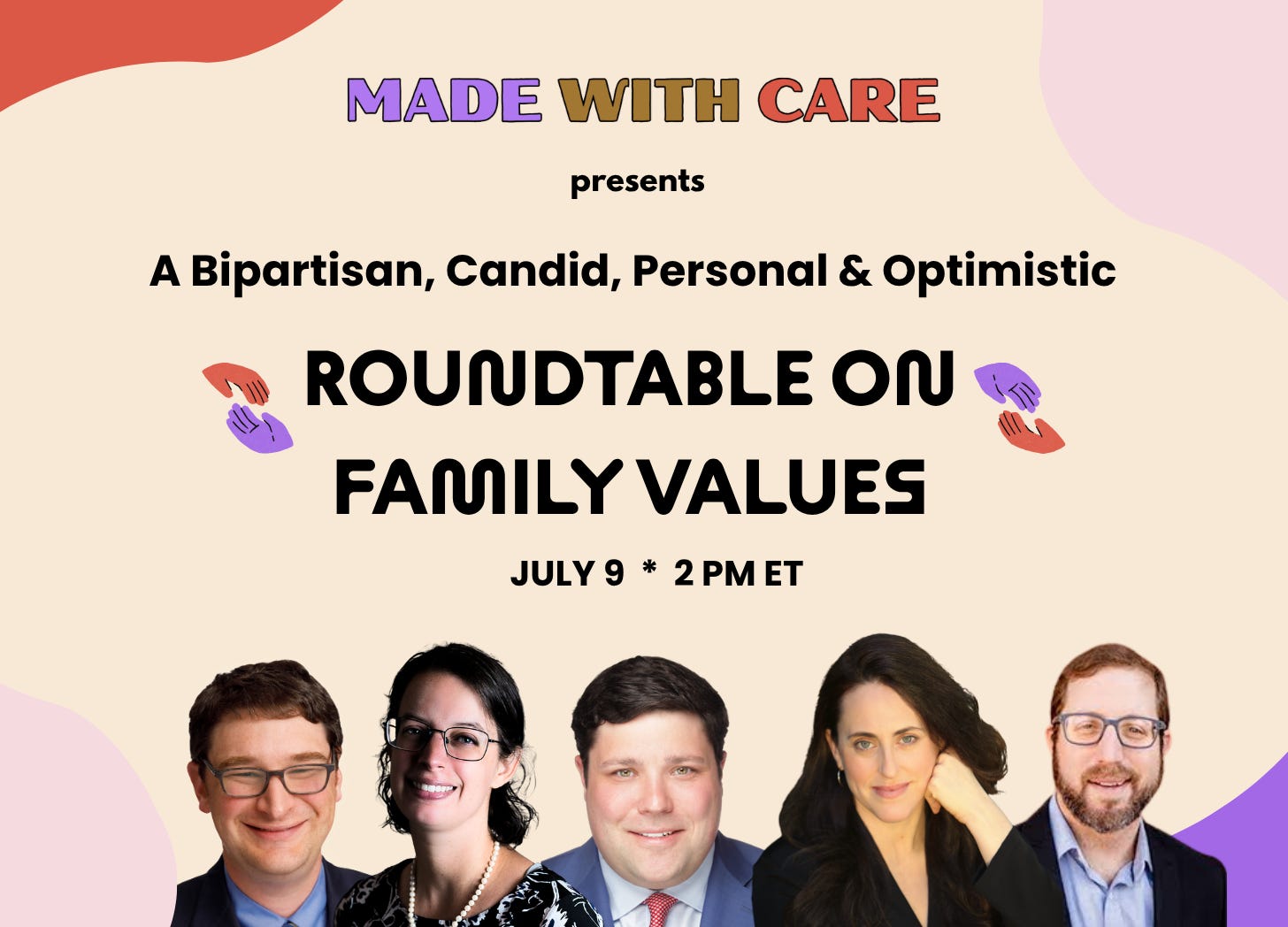
Mark your calendars! Some of my favorite voices from across the political aisle will be joining for a semiquincenntenialicious discussion of care, family, and values. Ivana Greco, Joe Waters, Elliot Haspel, and myself will be hosted by Elissa Strauss at her Substack, MADE WITH CARE, on Tuesday, July 9, at 2 p.m. EST. The discussion will be held on Zoom, free to all subscribers of Elissa’s newsletter — luckily for you, she is offering a 15% discount to those who sign up. Join us!
Parting Shots
Everything Yuval Levin writes is worth reading, but that especially goes for his reaction and reflection to the Pope’s encyclical Magnifica Humanitas — including thoughts on where it doesn’t go far enough, and where future work on AI and ethics should focus (The New Atlantis)
Indiana Gov. Mike Braun is having his state review child care regulations, including getting rid of degree requirements for child care workers, allowing different age groups to mix at the end of the day, and permitting centers to use sleeping mats instead of elevated cots, among other provisions (Indiana Capital Chronicle)
In Pennsylvania, House Republicans are proposing a fourteen-bill package of child care updates, including clarifying requirements, reducing some regulations and — most intriguingly — offering low-interest expansion loans to child care providers.
Sara Mickelson reports on the difficulties New Mexico is facing in standing up their new child care scheme — as it turns out, simply subsidizing demand is not enough to build out enough options for parents, and in fact is crowding out the lower-income parents who the system was originally designed to help. A cautionary tale for would-be universalists! (Vox)
In a new book, Tim Goeglein of Focus on the Family weighs in on some of the debates around family, marriage, and masculinity. It’s a nice summary of where social conservatives have been all along — and correctly so — stressing the importance of healthy marriages to a flourishing society and a healthy model of masculinity for helping young men find the role models and scripts they need to thrive. At a time when the online debates around sex, family, and gender feel increasingly heated (and often, counter-productive), “What Really Matters” is a reminder that there’s nothing new under the sun, and that sometimes revisiting old debates can help you find a richer perspective on contemporary ones.
Daniel K. Williams lays out a compelling understanding for why pro-life Democrats — always endangered — are now extinct, including the secularizing of America and the shifting racial politics in the South (Politics of the Cross)
Audrey Fahlberg reports on the growing tensions between the institutional pro-life movement and the White House, including some previously unreported details about a meeting between President Donald Trump and Lila Rose that gives some insight into the President’s personal views on the issue. (The Free Press)
Family Matters readers will recognize some of the points made in Matthew Yglesias’ write-up of the New America covered in last week’s edition, but his post has some political advice Democrats should consider. (Slow Boring )
Scott Greer’s politics are very much not my own, but the read of the cultural moment offered at his Highly Respected Substack feels right: The vibe shift is over, dead at the hands of some of the Trump administration’s self-inflicted wounds, but what comes next remains to be seen.


Comments and criticism both welcome, albeit not quite equally; send me a postcard, drop me a line, and then sign up for more content and analysis from EPPC scholars.
The same bill would have uncritically claimed that “for every $1 invested in universal preschool, $9 in benefits, including better child health and increased earnings, is returned to the economy,” which is a pretty bold statement that arguably outstretches the research literature, relying on James Heckman’s research into a highly-intensive early childhood program (Perry Preschool) and extrapolating that to universal preschool writ large without accounting for the difficulties of bringing a human services program to scale or recognizing the different socioeconomic climate facing low-income children in 1960s Michigan.
“All income groups value healthy groceries, but the highest-income group is willing to pay the most, making healthy eating a normal good.” (p. 27)