

Pluralism Ascendant
The policy conversation around parenthood is shifting to a more productive place

South Carolina experienced a mysterious sonic boom yesterday evening, so if extraterrestrials are found in the Lowcountry, you heard it here first. If it’s Friday, it’s Family Matters:
Diff’rent Strokes for Diff’rent Folks: New report stresses parents’ heterogeneous preferences
Oh, the Magnificent Humanity: Pope Leo XIV’s latest remarks
Encyclical Webinar — June 2: Virtual conversation on Magnifica Humanitas
It’s Me, Hi: POLITICO
Looking for a Few Good Men and Women: Richard John Neuhaus Fellowship
Parting Shots
Diff’rent Strokes for Diff’rent Folks
The tectonic plates of family policy move slowly — but they are moving.
In 2021, the progressive left was riding high — they knew their solution for the problems facing American families and it was the “American Families Plan,” the “social infrastructure” component of the Build Back Better reconciliation package. It was legislation by, of, and for The Groups — a paid leave, a universal pre-K, and a child care subsidy approach all designed independently of each other and then bolted together at the last minute.
During these debates, Matthew Yglesias pointed out at his Substack, Slow Boring, that the Frankenstein’s monster approach to the legislation left a key question partially unanswered: “What are we trying to achieve with our early family policy?” Instead of neutrally supporting families with young kids, Yglesias argued, “Democrats have written a bill that, WWII-style, subsidizes child care rather than the cost of parenting, which might include child care.”
As I wrote at the time, this was the result of a cultural blind spot influenced by interest group politics. Many of the architects were college-educated professionals who were (or knew people who were) paying uncomfortably large amounts for professional child care, and many of the loudest supporting voices were groups pushing for higher wages for child care workers. As a result, the plan focused heavily on increasing wages and subsidizing costs for formal child care without asking whether that was, actually, what parents wanted.1
We know now the answer was — not really. There have been a series of polls suggesting that the voices of parents looking for something other than full-time work and center-based care are underrepresented in the D.C. dialogue. And the latest entry stressing that point is the 2026 National Parent Survey, which comes from New America, a leading center-left think tank. The poll’s findings, if taken seriously, could help ratify an ongoing shift among the “groups” that used to prescribe more rigid approaches to early childhood supports — and chart a new, more productive path forward for many of our family policy conversations.
In some respects, the entire report could be summed up in one bullet point from the executive summary:
“Parents want different types of work, care, and leave arrangements. Most want to work—but not the same amount. And parents’ preferences for who provides care for their kids differ as they grow.”

In a country that’s as big, diverse, pluralistic, and complex as ours, a policy program that starts by embracing different preferences for work, care, and leave will lead you in a different direction than one that assumes a predominant model that some may deviate from. We might shorthand this as the difference between the “Care Economy” and a family-centered economics.
For instance, 72 percent of parents reported wanting more quality time with their children, while only 24 percent of parents said they wished they had more time for paid work. (In theory, those two groups don’t even have to be distinct!) But a BBB-style subsidy that only subsidizes formal child care increases the returns to paid work while making time at home out of the labor force more costly. In other words, Build Back Better would have put taxpayer money on the opposite side of the work-life equation from what many parents say they want.
In other words, as the report lays out: “No single preferred work schedule is chosen by more than 46 percent of parents, no single child care arrangement by more than 31 percent, and no single leave duration by more than 38 percent, suggesting that parents’ needs are genuinely plural.” (emphasis mine)
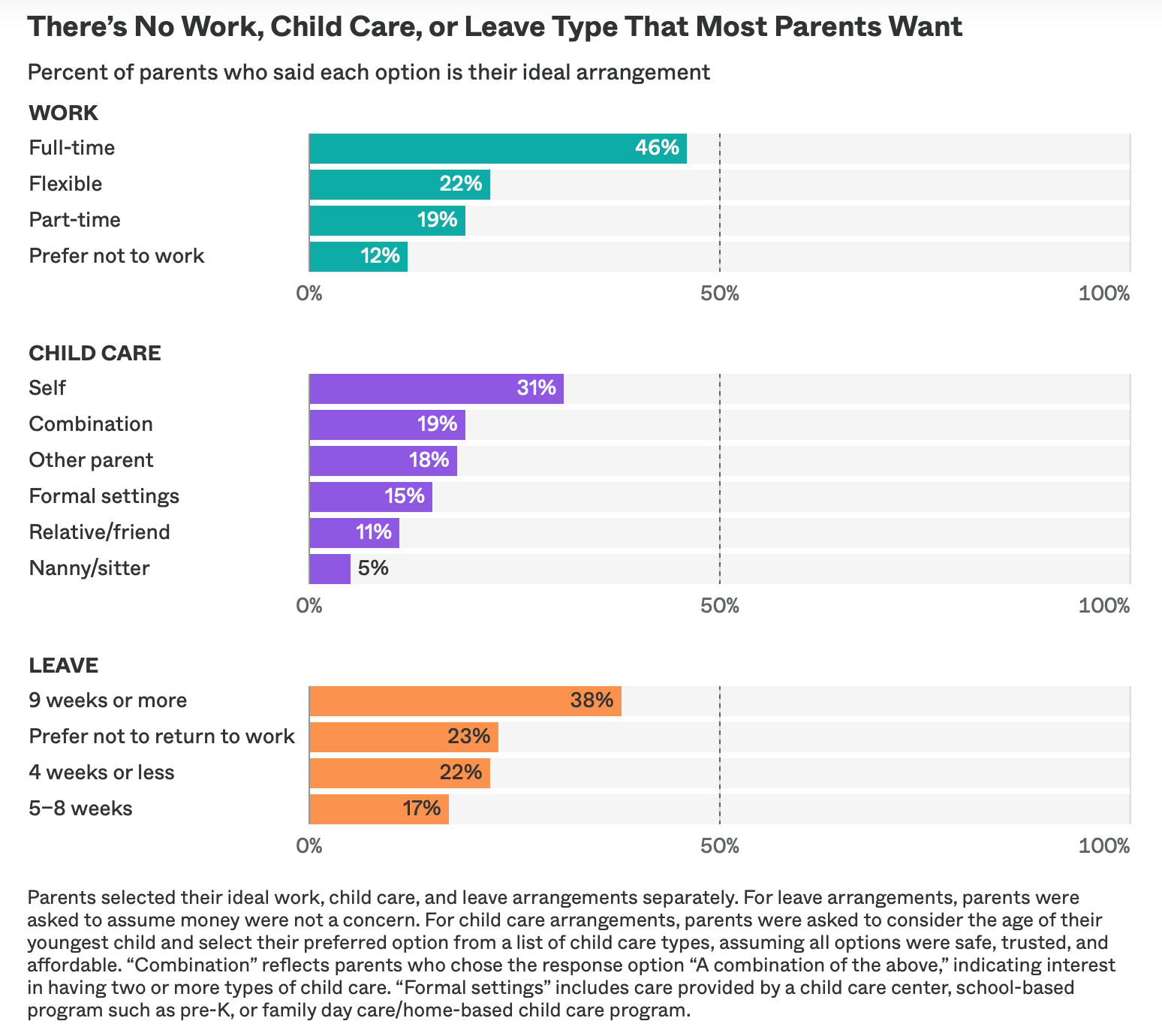
The correct way to read this chart is to recognize that each question is asked separately, and it’s not the same block of parents responding that they both want to work full-time and to provide child care themselves. Instead, parents are genuinely divided about what their “ideal” looks like, even as some broad desire for more time with kids emerges. For instance, there is a wide spread of attitudes around parental leave, even as 55 percent of parents reported wishing they had been able to spend more time with their new baby (a cause which, as I wrote last week for Deseret News, more Republicans should think more creatively about).
This even goes for parents who are currently working full-time: 71 percent of dads say they want to continue working full-time, all else being equal, while only half of moms working full-time said the same thing.
After BBB flamed out, and the 2024 election showed progressives that their grasp on the views of the median American may have been less well-founded than they thought, there are signs of a growing shift toward an understanding of family policy that is more egalitarian and — to use my favorite word — pluralist. In Rep. Ro Khanna’s $10-a-day child care proposal, for example, he included a $3,600 stipend for parents of kids under 3 who opted for at-home care. Mayor Zohran Mamdani gestured towards pluralistic support for families during his campaign, but has not produced a plan that would enable New York City parents of young children to stay home with their young children — even as demand for the city’s free 3K program flatlines. At The Bulwark, Lauren Egan got a look at the first policy proposals from Project 2029, a group that wants to replicate the playbook approach of Project 2025. In it, the group gestures to the fact that many families “can’t afford to stay home” and that the next President should give “parents back the power of choice on how to support their young children.” The proof will be in the pudding — but that rhetoric could lead to some interesting policy proposals, if taken seriously.
But that’s far from a foregone conclusion. Certainly not all progressives are noticing where the wind is blowing. “It would be political malpractice for Democrats not to be talking about childcare every chance we get, going into the midterms and beyond,” Senator Elizabeth Warren said at the Center for American Progress’s IDEAS Conference last month, per reporting by the Washington Examiner’s Mabinty Quarshie.
To put it bluntly, I do not think that is true. Child care costs are extremely salient for a relatively narrow slice of the electorate — namely, those with kids under six. Once you get past that window, it stops being as big of a motivating force. As Yglesias pointed out on Twitter, you can see this play out in public opinion polls — the share of voters who cite child care as a big concern for them personally is, essentially, a rounding error.


This is not just because most voters don’t have children under six, but because most parents with young children do not pay for child care! (two-thirds of parents with children under six do not pay for child care; table 9 here, though backed up in other surveys as well.)2 So a sharp focus on subsidizing child care alone will leave many parents out of the conversation.
But an authentically pro-family public policy apparatus — a message that encompasses a broad array of work-life situations, a policy that is most generous with support in the weeks and months after birth, and an approach that is able to distinguish the desires of the child care industry from the desires of parents3 — has more of a chance of getting people excited and solving more of the problems facing more families. (It’s an open question, I suppose, as to whether the cleanest policy solution (subsidize parents, not just child care) is also the most salient political approach, but I think there’s sufficient evidence to give it a go.)
This kind of vision has limited, though growing, purchase on the right. It may end up picking up steam on the left as well.
Oh, the Magnificent Humanity
As you may have heard, Pope Leo XIV’s encyclical letter Magnifica Humanitas was released earlier this week. Subtitled “On safeguarding the human person in the time of artificial intelligence,” it’s the kind of document that deserves to be mulled over and digested rather than quickly metabolized for hot takes, so if you came to Family Matters looking for hot insta-reaction to the encyclical — sorry to disappoint! (It’s available to read on the Vatican’s website, should you be so interested, and I also particularly appreciated my EPPC colleague Francis X. Maier’s commentary for the Acton Institute.)
Yet lost in all the encyclicitement was a speech the Holy Father gave earlier last week to an audience made up of representatives of the European Parliament. It deserves to be excerpted at length:
“The problems resulting from zero-growth demographics are many and complex, and include, not least, the pandemic of loneliness. Moreover, demographic data are not merely statistics, but speak of fatherhood, motherhood and children. And children are the future!…
“Furthermore, over recent decades, we can see that a rejection of the Christian inspiration of the founding fathers of the EU institutions has led to a time of drastic sterility, not only because too many have been deprived of the right to be born, but also because there has been a failure to pass on the material and cultural tools that young people need to face the future. As a result, we are not infrequently faced with the contradictory claims of purportedly family-friendly policies, which simultaneously promote discrimination against motherhood, exalt abortion as a right, and undermine the very foundation of the desire to start a family…
“At the heart of these pressing challenges, and the key to providing solutions, lie the fundamental dignity of all persons and the role of the family in society. As Saint John Paul II reminded us, the family is “the first and irreplaceable school of social life” (Familiaris Consortio, 43) and is founded on marriage between a man and a woman, a reality that unites the personal and public dimensions…For only by respecting and promoting this central place of the family, and applying the principle of subsidiarity, is it possible to avoid the two extremes of excessive State intervention and individualism…
“Finally, this approach is not a matter of returning to social models of the past, but of providing the men and women of our time with the unchanging principles that can surely guide them in answering the fundamental questions asked in every age: What is the meaning and value of human life; what is an authentic human society; and what kind of world do we want to hand on to future generations…Indeed, only a fresh springtide for the family can transform the winter chill of our ageing populations!”
That question is what Magnifica Humanitas seeks to address — and will, I hope, take up a large part of Pope Leo XIV’s pontificate.
Encyclical Webinar — June 2
Okay, so when I said I didn’t have hot insta-reactions to the encyclical, I was mostly telling the truth…But come next Tuesday, June 2, I intend to have appropriately thought about and reflected on Magnifica Humanitas enough to participate in a webinar on what the new encyclical means for the Church, young adults, and the pro-life movement.
Join me and Cynthia Schmidt, executive director of the Catholic Pro-Life Community of the Diocese of Dallas, for a conversation about the Pope’s new message, how Catholic Social Teaching can help inform our public policy discussions, and what the pro-life and pro-family movement can take from the Pope’s writings and insights.
📆 Tuesday, June 2, 2026 | ⏰ 1:00p ET/12:00p CT | 💻: Zoom [Register here]

It’s Me, Hi
At POLITICO, Alice Ollstein interviews me and other members of the pro-life movement about frustrations with the Trump administration’s slow-walked review of the abortion pill mifepristone and other pro-family priorities:
“You see some social conservatives, bless their hearts, talking about a third reconciliation bill which will be the one to go after Planned Parenthood,” said Brown. “But if you believe that, I got a bridge to sell you…
“Are there some die-hard pro-lifers who are going to be disappointed if the White House doesn’t [restrict mifepristone]? Absolutely. I am one of them,” said Brown. “But ultimately, there’s a lot of people out there who are still going to vote Republican because of immigration, crime, inflation, the war, or whatever it happens to be. And whether or not the administration did enough to get an A grade on abortion is not going to keep people home.” (POLITICO)
As a reminder — only paid subscribers are able to comment on Family Matters posts. Subscribe today to give yourself not just the phenomenal cosmic power of being able to comment, but the warm glow of supporting high-quality family policy writing.
Looking for a Few Good Men and Women
If you are a young, or young-ish, policy professional in or around Washington, D.C. with an interest in how America’s Judeo-Christian tradition influences public policy and the mediating institutions of civil society, you absolutely should apply for the Richard John Neuhaus Fellowship on American Flourishing.
Co-hosted by the Ethics and Public Policy Center and The Public Interest Fellowship, the Fellowship explores the underpinnings of American public policy, with an eye towards the intersection of faith and public life in areas ranging from constitutional governance, education policy, family policy, economics, technology, bioethics, and more.
If this sounds interesting, and you or someone you know has two to eight years of professional experience (particularly in government, journalism, and think tank-type work) and is able to attend in-person programming in Washington, D.C., apply now! Tell ‘em Family Matters sent you.
Comments and criticism both welcome, albeit not quite equally; send me a postcard, drop me a line, and then sign up for more content and analysis from EPPC scholars.
Parting Shots
The new app for Trump Accounts has officially launched — available at an app store near you — and it was fascinating, heartening, and a little inspiring to hear Vice President JD Vance talk about the importance of good end-user design in promoting the new app: “Great policy only works when people can actually use it. That is the power of design. When government is easier to understand, easier to navigate, and easier to trust, people benefit. The American experience should be as great as the American promise.”
 JD Vance@JDVanceOne of the problems we have in public policy is that wonks don’t give any consideration to how their ideas will collide with actual human behavior. Take our Trump Accounts. There are millions of parents who will in theory benefit enormously from this investment in their kids’
 The White House @WhiteHouseIT’S HERE! 🇺🇸💰 The Trump Accounts App has officially launched. Now every family has a simple, direct way to get involved and build their child’s future. Download it TODAY on any App Store and make sure your kids are ready for the massive July 4th official launch. 📱1:04 PM · May 29, 2026 · 777K Views831 Replies · 2K Reposts · 10.4K Likes
Will Thibeau has an interesting policy idea for an ambitious pro-family legislator — change TRICARE rules to exclude maternity care for any military spouse hired as a commercial surrogate (First Things)
Kellen Browning and Emma Goldberg report on the young men who are unhappy with what both political parties are offering them (New York Times)
Charles Hilu offers a fascinating report into the unlikely coalition maintaining the fight against assisted suicide in Connecticut (The Dispatch)
Roni Caryn Rabin reports on the latest RxKids study that finds the cash assistance program led to better health outcomes for babies (New York Times)
Megan McArdle weighs in on the Great Smartphone and Fertility Debate, finding (correctly) a need to “rewrite the social contract” around phones and interpersonal connection or else watch birth rates continue to drop (Washington Post)
Allan Carson suggests that we already had a pro-family federal policy push in the first half of the 20th century, and that it was successful — one question is how much these policy efforts were creating a new consensus or simply reflecting one that already existed (Family Studies)
A push to mandate health insurers cover in vitro fertilization failed in the Minnesota state legislature (Minnesota Star Tribune)
The Mississippi Department of Human Services is directing $5 million of TANF funds to expand child care assistance to low-income parents through the state’s voucher system


A similar dynamic took hold on the paid leave portion of the bill, which sought to advance an expansive, expensive paid leave program that encompassed a number of various situations an employee might want paid time off of work, even as polling (and most rhetorical support for the bill) demonstrated the strongest level of support was for a benefit targeted at new parents.
Many more than that use some form of non-parental child care — about 60 percent of kids under six. But that includes unpaid relatives, unorthodox shifts, co-ops, or other unpaid forms of care.
Sometimes they overlap! At other times, they do not. Take Minnesota, which just passed legislation that will raise compliance standards on home-based child care providers, which is expected to raise costs for parents and push some providers out of the profession.
The sonic boom was just Powers having a blowout. My bad