

Warning: Excessive Screen Time May Be Hazardous to Your Child's Health
The Surgeon General's new advisory and toolkit on reducing screen time in childhood marks a welcome new phase

If it’s the Friday before Memorial Day, it’s a condensed, though still scintillating, Family Matters:
Unsafe at Any Download Speed: A new Surgeon General report on screen time
It’s Me, Hi: Deseret News, Daily Wire, New York Times
Looking for a Few Good Men and Women: Richard John Neuhaus Fellowship on American Flourishing
Parting Shots
Unsafe at Any Download Speed
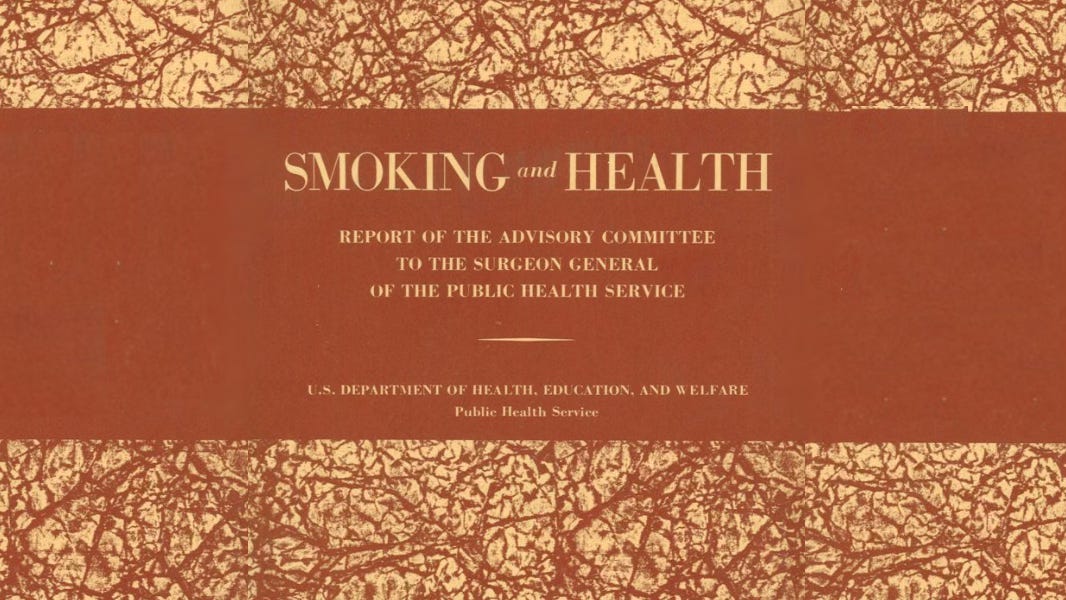
In 1964, Surgeon General Luther Terry released a 387-page report that had taken ten men fourteen months to write. He summarized the findings, based on an exhaustive review of the available studies, much more concisely at a news conference: “I would advise anyone to discontinue smoking cigarettes.” At the time, 42 percent of American adults smoked cigarettes.
It took decades for America to implement the aggressive anti-smoking measures that took smoking rates down from 42 percent of American adults at the time of the report’s release to 12 percent in 2022 (younger Family Matters may not recall that restaurants were still offering “smoking” and “non-smoking” sections up into the 1990s). It’s not that no one prior to 1964 had ever thought smoking might be bad for you. But the Surgeon General’s report was instrumental in turning a personal choice into one that had political ramifications: “Cigarette smoking is a health hazard of sufficient importance in the United States to warrant appropriate remedial action,” the report found.
The office of the Surgeon General, much like the entire public health apparatus, has seen its prestige and implicit levels of public buy-in go down since the high-trust post-War period. But it’s still notable when the Surgeon General releases an advisory, reserved for “urgent public health issues” that “require the nation’s immediate awareness and action.” And this week, the Office of the U.S. Surgeon General released an advisory and toolkit on the harms of screen use for children and adolescents. It’s welcome, practical guidance based on what we know and what we don’t know about the roles that screens play in young people’s lives — and why we need better public action to tackle it.
The document’s summary offers a sample of its vision for the role that policy can play:
“Parents, caregivers, schools, communities, health care providers, and children and adolescents themselves have an opportunity and responsibility to help reduce the role of screens in the lives of our nation’s children. Likewise, policy makers and tech companies need to acknowledge the potential for harm and create frameworks to protect children to allow for healthy and joyful use. Policy makers should also seek to create safe community spaces for play, learning, and connection without screens.”
The report mostly avoids scaremongering, admitting that the research base on harms for digital childhood is “mixed,” relying heavily on associational rather than causal work, there remains “sufficient evidence of potential harms” to merit appropriate steps. After all, the case for prudence on tech is strongest when it comes to childhood. Everyone can see the impact social media, short-form video, and digital tech are having on all manner of aspects of adult society. Why wouldn’t we want to urge caution before plunging full-speed ahead on kids’ brains and social skills?
This approach won’t be anything new to anyone who has ever read a piece by Jonathan Haidt or Jean M. Twenge. But while the kind of parent who read “The Anxious Generation” — broadly stereotyping, parents who read books about parenting and worry about cultivating resilient and gritty high achievers who will have a shot at a selective college in a decade — knows about the need to curb or tone down a reliance on screens, many parents who don’t have the time or inclination to follow the Discourse can benefit from top-down guidance.
The push for bell-to-bell phone bans in public schools is primarily being led by elites — as most policy change tends to be. Affluent parents can pay for hands-on after-school classes in lieu of the electronic babysitter, or seek out private schools or camps that pride themselves on being screen free. But many working-class parents haven’t given much thought to the downsides of relying on an iPad to keep a kid quiet during dinner, or belatedly found out their pre-teen signed up for Instagram and have little desire or capability to enforce a dubiously-effective ban. Lower-income families also frequently have fewer safe spaces for children to gather and play, more unpredictable work schedules, and less ability to buy into curated, screen-free environments. They could absolutely benefit from schools, states, cities, and other institutions taking the recommendations in the toolkit seriously, and becoming part and parcel of a pro-family approach to tech and social policy.
The advisory encourages individual families to create a “family media plan,” including screen time limits, screen-free zones and times, and encouraging parents to be deliberate about screen time use. It even explicitly encourages parents to “Delay giving children access to tablets, smartphones and social media as long as possible” and to “discuss why you are limiting or controlling access to certain devices, platforms, or media.” If that guidance makes its way to pediatricians’ offices and elementary school handouts across the country, it will be doing American families a great service.
But this effort has to be more than just families on their own. They urge schools to enable “distraction-free teaching” and “create opportunities to displace screen time,” and encourage policymakers to “take steps to increase safe access to alternative activities such as parks, playgrounds, recreation centers, libraries, and after-school programs.”
This is a different vision of pro-family tech policy than the conversations that tend to end up in high-level fights over age verification, “duties of care,” screen time limits, Section 230, and other policy debates. Instead, it recognizes that incrementally shifting the burden from parents to tech firms to keep kids safer online — a laudable goal, to be sure! — won’t be enough if there aren’t proactive steps being taken to make “IRL” childhood more attractive and vibrant than its digital simulacrum.
That’s why the push to save childhood from digital dependency needs to operate on a faster timescale than the social pressures that made smoking less common. It wasn’t until 1984 — two decades after the initial “Smoking and Health” report — that Congress mandated a Surgeon General’s warning be printed on all cigarette labels in a conspicuous way. We don’t have that kind of time.
My EPPC colleague Clare Morell, who has been a vocal advocate for a screen-free (or at least -minimized) childhood, tweeted earlier this week that she has “never been more encouraged” about the cultural momentum against a childhood intermediated by technology.

You don’t need to draw a full analogy between Big Tech and Big Tobacco to recognize the downsides of a childhood lived too online. (Cigarettes, after all, are inherently harmful in a way that technology is not.) Verily, I say to you, let he who has not let his toddler watch (m)an(y) episode(s) of Wild Kratts on an iPad cast the first stone. But part of equipping parents to make the right choices for their child means changing the physical and digital environment to give parents actual choices — allowing the digital world to colonize the physical one means crowding out some of the habits and institutions that parents used to be able to rely on.
This week’s advisory deserves to be taken seriously as a moment where some parts of the public health apparatus issued a big, red flag on the need to do more to help parents raise happy, well-adjusted kids. Even the most well-meaning parents can’t do it on their own, and many harried, overburdened parents don’t know where to start. A pro-family tech policy agenda must also be a pro-social one — and the Surgeon General’s advisory should galvanize those efforts just as effectively as its 1964 predecessor did.
It’s Me, Hi
For the Deseret News, I look at options that might enable states to tweak existing child care and welfare programs that could enable low-to-moderate income families who want to have a parent at home while their new baby is under one year old to be able to do so:
“Taxpayers may rightly look askance at limited childcare dollars going toward enabling the mom of a 4-year-old to stay home full time. But for babies under the age of 1, when costs are highest, receiving federal permission to give families who want to use federal childcare dollars to enable a parent to stay home could make fiscal sense. Indeed, Montana and Minnesota each piloted a similar option in the early 2000s, experimenting with welfare reform to fund At-Home Infant Care rather than subsidizing pricey childcare.
“Today, only families whose babies are cared for by someone who is not the child’s parent are eligible for CCDF support. That approach might make sense as kids get older; after all, 80% of households receiving childcare assistance are single parents, who we may rightly want to help establish a connection to work. For newborns and infants, however, we should explore more flexibility.” (Deseret News)
In my first piece for the Daily Wire, I recap some of the Trump-Vance administration’s recent moves rolling back excessive federal regulation around child care assistance programs, and suggest their emphasis on parental choice is a fruitful angle for federal child care policy:
“For many parents, the right child care provider isn’t the one that scores highest on a clipboard checklist of various “quality metrics.” It’s the one that speaks the same language as their child, shares their faith, is located near the office, or is the one their child’s friends all attend as well.
This is the spirit that animates ACF’s guidance. While care by relatives, friends, or neighbors is provided for in the statutory text of the child care block grant, it tends to be given short shrift by too many states, whose accumulated regulations and red tape naturally favor larger, more established providers. The administration stresses that making parents aware of this kind of informal care “could expand the supply of home-based child care,” and reminds states that they can exempt certain informal care arrangements from licensing requirements so long as they do not endanger a child’s health or safety.” (Daily Wire)
My Family Matters installment on the misconceived rush to lay the blame for falling fertility at the feet of the “girlboss” was cited in Jessica Grose’s latest newsletter for The New York Times:
“[T]hough Brown is also a conservative, he disagrees strongly with Miller and her compatriots. There’s been an increase in births by college-educated mothers, while births by women without high school diplomas have decreased and women with college educations are more likely to be working than those with less education.”
And my EPPC colleague Nathanael Blake cited me (and this very newsletter!) among other religious pro-family conservatives that those interested in declining birth rates should be reading in his column for The Federalist.
“[Those] who claim to care about the baby bust ought to pay attention to the religious conservative family policy wonks, because they represent the only Americans still having plenty of babies.”
As a reminder — only paid subscribers are able to comment on Family Matters posts. Subscribe today to give yourself not just the phenomenal cosmic power of being able to comment, but the warm glow of supporting high-quality family policy writing.
Looking for a Few Good Men and Women
If you are a young, or young-ish, policy professional in or around Washington, D.C. with an interest in how America’s Judeo-Christian tradition influences public policy and the mediating institutions of civil society, you absolutely should apply for the Richard John Neuhaus Fellowship on American Flourishing.
Co-hosted by the Ethics and Public Policy Center and The Public Interest Fellowship, the Fellowship explores the underpinnings of American public policy, with an eye towards the intersection of faith and public life in areas ranging from constitutional governance, education policy, family policy, economics, technology, bioethics, and more.
If this sounds interesting, and you or someone you know has two to eight years of professional experience (particularly in government, journalism, and think tank-type work) and is able to attend in-person programming in Washington, D.C., apply now! Tell ‘em Family Matters sent you.
Parting Shots
Telehealth abortions made up more than one quarter of overall abortions by the end of last year, reports Claire Cain Miller and Margot Sanger-Katz (New York Times)
Ohio gubernatorial aspirant Vivek Ramaswamy plans to eliminate income taxes on capital gains, such as stocks, bonds, and real estate, with the aim of eventually eliminating the state’s income tax. His opponent, Dr. Amy Acton, is pitching a refundable earned income tax credit and child tax credit in lieu of broad-based tax cuts. (Columbus Dispatch)
Minnesota legislators passed a bill that will require children under 16 to have parental consent to create social media accounts, default privacy settings to their highest levels, and strip down features like push notifications. (Minnesota Catholic Conference)
Illinois lawmakers are seeking to create an Abortion Access Fund Grant Program, which would use money from the state’s health insurance exchange to fund abortion access for un- and under-insured pregnant women.
“A newborn credit seeks to help a well-defined group in a way that is easy for families to claim,” write Margot Crandall Hollick and Elaine Maag for the Tax Policy Center, noting that a $500 version of the newborn tax credit could have a ten-year budget score of just $18 billion. “It’s an untested but potentially powerful idea.”
Pamela Paul explores the progressive push to decriminalize prostitution, and alternative approaches to actually help women leave the industry — I did not know 20 states are currently weighing legislation to increase penalties on buyers, rather than sellers, of sex (Wall Street Journal)
The State Department is revoking passports from parents who owe six figures in child support or more, with the intent of eventually scaling that threshold to $2,500 or more (Daily Caller)
If you’re at all interested in the state-by-state laws governing surrogacy, polyamorous parenting, and other progressive approaches to family building, the coalition Them Before Us has put together a useful scorecard.
Comments and criticism both welcome, albeit not quite equally; send me a postcard, drop me a line, and then sign up for more content and analysis from EPPC scholars.