

Suomi The Money
Augmenting Trump Accounts with an eye towards the future could pay demographic dividends

The only silver lining of the U.S.’ embarrassing crash-out against Belgium earlier this week is that it gives us more time to enjoy the race for the Golden Boot (most goals scored during the World Cup) between Argentina’s Lionel Messi, France’s Kylian Mbappé, Norway’s Erling Haaland, and England’s Harry Kane. (The championship remains les Bleus to lose, as was predicted by Family Matters at the tournament’s outset.) If it’s Friday, it’s Family Matters:
The Finn-ish Line: Standing athwart fertility doomerism, yelling “pysähdy”
Can We Actually Regulate Vice?: Yes. Duh.
Laudable Bicameral Bipartisanship: Joint letter on discrimination against the disabled and elderly
It’s Me, Hi: Washington Examiner, The 19th, Washington Post, Civitas Outlook
Parting Shots
Point of Personal Privilege: Today’s Family Matters is our special centenary edition on Substack! To the roughly 49 percent of you who have been there since the beginning, thank you! And to the other 51 percent of you who have signed up since; get to reading the archives! You are, of course, always cordially invited to upgrade your subscription to support high-quality family policy newsletter writing, but I appreciate all of you for spending time on these topics these past 100 Fridays — with more to come…
The Finn-ish Line
Finland (Suomi, in the native tongue) is considering one of the most innovative ideas for tackling the decline in births. Could America get there first? We’re not as far away as you might think.
For a decade, the biggest battle was to get people to take the fertility decline seriously. Lots of people thought birth rates would bounce back, or that it was just a temporary dip as people had more choices, or that immigration would cover up any decline in native-born fertility. But it increasingly feels like just as the world is taking falling birth rates more seriously, we’re skipping right to the stage where we throw up our hands and declare there’s nothing that can be done about it, or that the “cure would be worse than the disease.”
In National Review last April, I took on this increasingly-prevalent defeatist mentality:
“One flavor of feigned helplessness comes from places like ABC’s The View and other peddlers of pop progressivism. Childlessness, in this telling, is a rational response to the predations of late-stage capitalism (or patriarchy, or racism, or cis-heteronormativity, or fill-in-the-oppressor). You have the gall to sit there and tell people it’s okay to have kids? On a planet that is literally burning? In this economy?…
“[Meanwhile,] many conservatives correctly observe that low birth rates aren’t caused by the out-of-pocket cost of child-care or anxieties du jour like climate change, but this can slip into a kind of fatalism. Why tinker with the gears and levers of policymaking when the only things that ultimately matter are religious beliefs and cultural behaviors that are, appropriately, beyond the state’s direct influence?
“The fatalist attitude partly reflects political reality: a coalition that disproportionately caters to older voters is necessarily going to find it hard to prioritize ideas aimed at younger, less dependable voters. But limply gesturing at the black box of “cultural change” in lieu of a responsive policy agenda is throwing in the towel before the opening bell—like Ned Flanders’s parents in an early episode of The Simpsons, they’ve tried nothing and they’re all out of ideas.”
When it comes to birth rates, America is both in a more enviable position than most of the developed world and also has not particularly begun to fight. One of the countries that has, in fact, begun to fight has the population of South Carolina, the GDP of Utah, and shares a border with a country currently engaged in belligerent military actions. If the Finns can start to get serious about fertility decline, why can’t we?

Finland already offers a fairly generous suite of child and family benefits, including a universal child benefit (with higher amounts for young children), a baby box (or, optionally, cash payment) with infant supplies offered at childbirth, parental leave, expansive funding of child care plus a home care allowance for parents who opt out of using child care, and a heavy focus on sports and community centers to ensure a wide availability of youth activities.1
But while those provisions may make life easier for parents — a laudable enough goal, in my opinion — they have not proven sufficient to insulate Finland against the broader decline in fertility, and the collapse of the theory that the Scandinavian model would be enough to sustain birth rates. For most of the 1990s and 2000s, Finland and the rest of the Nordics had fertility rates noticeably higher than the European average — no longer.

To address this, Väestöliitto, the Family Federation of Finland, has proposed what they are calling the Intergenerational Baby Fund, or vauvarahasto. The approach mixes a little bit of upfront spending with a focus on the “desired/realized fertility gap,” and applies the magic of compound interest to supersize a “baby bonus” approach to increasing birth rates.
Under this proposal, the Finnish state would create a €5,000 account ($5,710 in current US dollars) for every child born in Finland, which would then be invested in an index fund, not dissimilar to the newly-launched Trump Accounts. But whereas the Trump Accounts are, essentially, a retirement account (the funds can’t be touched until age 59½, with some penalty-free withdrawal exceptions like paying for college or making a first-time home down payment), the vauvarahasto would be directly tied to fertility. When that child grows up, and one day gives birth to their own child (so long as they still reside in Finland), they unlock access to the accumulated balance of the invested funds. If they do not have a child by age 45, the money gets recycled into the investment pool.
In other words, even assuming a conservative real rate of return, a couple from Rovaniemi expecting their first child a few decades hence would be sitting on a €26,000 “baby bonus.” That’s half of the current median household income in Finland (a comparable payment in the U.S. would be equivalent to about $40,000). Compared to the $2,000 and $5,000 baby bonus proposals that have been floating around in the ether, that’s a pretty hefty willingness to support — or, if you prefer, incentivize — potential parents who might be newly willing to take the plunge.
Because it takes time for the principal in the fund to grow, Väestöliitto also proposes a near-term stopgap, giving first-time parents €5,000 upfront, with a €2,000 payment for second children and €500 for third births. By 2046, they estimate, the first fund recipients would begin having children and the payouts would begin, with the interim payments gradually being phased out in favor of the full amount by the 2060s.
It’s an improvement on Trump Accounts, which largely benefit parents who have the means to put their extra disposable income in a long-term savings account. By contrast, the Finnish program would be egalitarian — “a fund share is opened for every child born in Finland regardless of income level.” The program also — laudably — scales the benefit per parent, rather than strictly per child. Even in socially progressive Finland, Väestöliitto’s proposal would, appropriately, reflect the importance of involved fatherhood and scaling benefits by the number of individuals that make up the household.
You could imagine a line of critique going something like this — why do we need to create the individual “share” approach, relying on compound interest and delayed gratification, when we could be funding such an approach out of general revenues? Or, barring that a sovereign wealth fund?
The first objection is dealt with simply; the dollar amounts that would be necessary to meaningfully bump fertility rates up are likely out of the range of most budget-constrained governments (that is to say, all of them.) Remember — it’s not that pro-natal incentives don’t work; it’s that they’re very expensive. Assuming away the potential impact of AI, end of capitalism, or heat death of the universe, putting aside money today will make it easier to afford pro-family incentives tomorrow even given an aging population and an expensive welfare state.
I’m not convinced there is a solid policy rationale for making the shares individualized, rather than a collective “Intergenerational Wealth Fund” that pays out a given amount at the prescribed time, but it does fit nicely into the precedent created by Trump Accounts. Politicians are celebrating Trump Accounts for helping young people “buy in” to the concept of free market capitalism and stock ownership; all the more should they celebrate the same concept applied to the work of shoring up the family as the building block of a healthy civilization.
The lowest-effort way to adopt this mentality would be to tweak the Trump Accounts structure to increase the amount new parents could withdraw from their retirement plans to say, $15,000 per parent, up from the current limit of $5,000. It still wouldn’t be good enough, given the way that Trump Accounts (and other savings-based vehicles) mostly benefit parents who have excess disposable income (and whose heirs, presumably, won’t be hindered by finances when considering starting a family as much as those whose parents came from more middle-class backgrounds.) Those who didn’t have much to put into the accounts in the first place, obviously, wouldn’t benefit much. But it would be a start. Ultimately, a long-term wealth fund approach, coupled with upfront cash assistance to today’s parents on top (or in lieu of?) the Trump Account seed money, would make sure we weren’t pitting people’s retirement security against their fertility goals.
The Institute for Family Studies’ Lyman Stone and Peter Foreshaw Brookes propose adopting the vauvarahasto approach on steroids. They would like to see $17,000 in up-front seed funding, and then following the Finland example along most parameters (they would, for example, shift the window of eligibility to ages 21—50.)

I don’t think you need nearly that amount of up-front capital to harness the power of this idea, and I’m not as convinced as Stone and Brookes that the possibility to push low-income households over various thresholds to make them lose safety-net benefits is a feature rather than a bug, one that could be avoided by making the disbursal non-taxable income. But the general principle is sound and deserves to be added to the quiver of pro-family ideas that we could pursue if only Mike Pence (and, in fairness, many other Republicans) had the courage.
Can We Actually Regulate Vice?
Other people summarize family-related white papers more reliably and more in-depth than I do (shoutout to Stephanie H. Murray’s “Family Stuff” for doing so on a weekly basis!) but every once in a while a new NBER working paper is too juicy not to spend a bit of time on.
We often hear that attempting to legislate against vice, like drugs or sports gambling, is pointless because the demand is, essentially, perfectly inelastic. If we make it harder for people to access vice legally, the argument goes, they will just turn to the black market to get their fix — and possibly even end up worse off than under a regime of toleration.
That is quite silly on a theoretical level — do we really think that making sports gambling legal in most states didn’t lead to an increase in demand for the product, and that making it illegal (or only legal in-person rather than on an app) would correspondingly reduce demand? But a new NBER working paper from Matthew Brown and Devin G. Pope of the University of Chicago and Emily Davis of the University of Notre Dame find — unsurprisingly, by my lights — that putting age restrictions on sexually explicit content online leads to lower levels of consumption. In other words, even with VPNs and various other work-arounds, age verification reduces online porn consumption on the margin.
They are able to compare internet usage between the states that have adopted age verification and those that haven’t, and find that about these restrictions reduced overall time spent on adult websites by about 10 percent. As the below chart shows, when Pornhub — one of the largest explicit video providers — shut down in protest of state age verification laws, overall usage fell by a statistically significant amount, even accounting for users switching to sites that didn’t comply with the state’s law. They find that time spent on adult websites fell in states with these laws relative to those without “by roughly 0.5 minutes per machine, which is 8% of the baseline mean.”
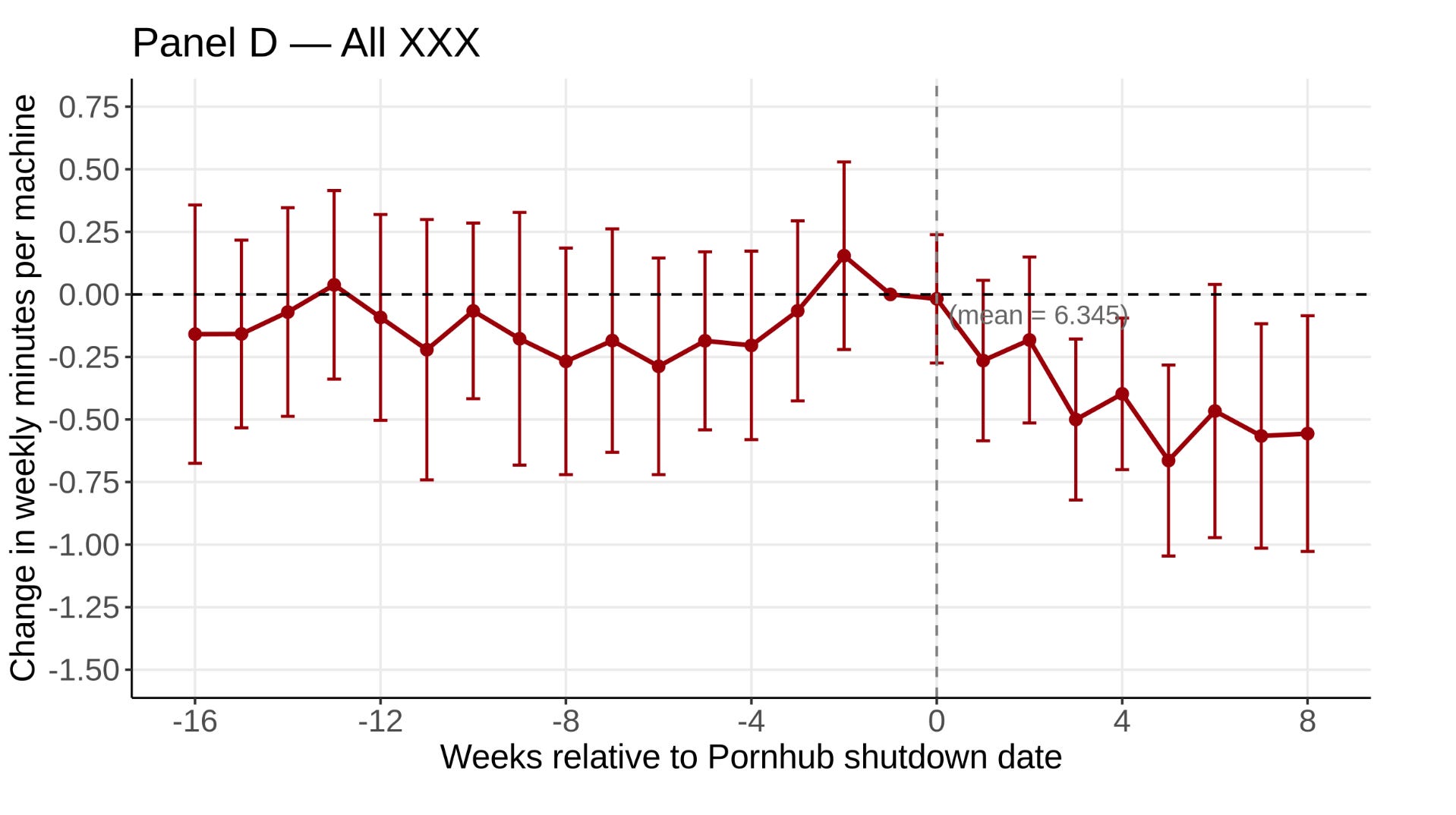
They point out that “technological circumvention and substitution toward alternative providers muted the impact of access restrictions on overall consumption. These results highlight that the design and enforceability of online regulations matter for their ultimate impact.” The point is well taken; but it also points out that even leaky restrictions can have an impact on casual use of content that has socially negative externalities. A finding worth taking into consideration as age verification and youth engagement with technology continue to be debated in Congress and elsewhere.
As a reminder — only paid subscribers are able to comment on Family Matters posts. Subscribe today to give yourself not just the phenomenal cosmic power of being able to comment, but the warm glow of supporting high-quality family policy writing.
Laudable Bicameral Bipartisanship
Most letters from Members of Congress go unnoticed; but one should inspire some hope for bipartisanship and recognition of human dignity. Senators James Lankford (R-Okla.) and Tim Kaine (D-Va.) and Reps. Greg Murphy (R-N.C.) and Luis Correa (D-Calif.) joined on a letter to HHS Secretary Robert F. Kennedy, Jr., to monitor assisted-suicide programs for discrimination against the disabled and other vulnerable adults.
“There are grave informed consent issues within physician-assisted suicide,” the Congressmen write. “An individual with terminal illness meets the definition of a disability under the Americans with Disabilities Act and the Rehabilitation Act of 1973. In fact, individuals with disabilities and disability civil rights groups have raised this argument and alleged physician-assisted suicide laws violate federal disability rights laws in litigation across the country.”
They also point out, logically, that “Physician-assisted suicide undermines America’s national posture of suicide prevention,” and that the U.S.’ laudable efforts to expand mental health resources to those considering taking their own life sits uneasily with advocates’ political and legal movements to remove guardrails from physician-assisted suicide programs.
The authors encourage Secretary Kennedy and CMS Administrator Mehmet Oz to “establish reporting requirements within hospice programs regarding physician-assisted suicide,” including monitoring for
Discrimination against individuals with disabilities, older adults, and other vulnerable populations;
Proper disposal of unused medication and prevention of drug diversion;
Insurance denials of life-sustaining medical care that offer to cover physician-assisted suicide drugs instead;
Drug complications;
Consistency of drugs prescribed “off-label” for use in physician-assisted suicide;
Compliance with federal restrictions on using funds, directly or indirectly, for health care items or services for physician-assisted suicide.
These are common-sense protections aimed at preserving human dignity in its final stages. The economic and autonomy argument for assisted suicide will continue to gain steam as the Boomers age, but there’s no reason why an effort to ensure that the elderly, disabled, and infirm are treated with respect needs to be a partisan issue. Kudos to the four Members of Congress for coming together for a bipartisan, bicameral letter on this topic, with hopefully more to come.
It’s Me, Hi
I spoke to Gabrielle M. Etzel of the Washington Examiner about the nomination of Chris Klomp as deputy HHS secretary, and why it will be important for him to work with social conservatives in his new role:
“I’m sure that someone with Klomp’s experience is familiar with the concerns that the pro-life movement has had with the Trump administration’s lack of action on their priorities,” Brown said. “It will be essential for Klomp to hear pro-life concerns about actions that could cheapen how the federal government treats unborn human life.”
And I spoke to Shefali Luthra of The 19th about the political fight to defund Planned Parenthood, and why the math of a razor-thin Congressional majority and a White House reluctant to devote political capital to the issue meant the one-year ban expired:
“At the time people were hungry for something that they could spin as a political win for the pro-life cause, and it wasn’t like it was nothing — but it was kind of the lowest-hanging fruit,” said Patrick Brown, a fellow at the conservative think tank the Ethics and Public Policy Center. “I can’t say I’m terribly surprised that even that low-hanging fruit is not able to be plucked again.”
My 2023 Public Discourse piece on the social capital-enhancing aspects of sports was cited by Shadi Hamid in his Washington Post piece (citing Michael Novak!) on how he became a convert to the social utility of belonging to a community of sports fans.
For Civitas Outlook, Jeff Degner engages with the proposals laid out by me and Allan Carlson, suggesting that his solution to uproot and eliminate the welfare state would be better.
These United States
Michigan: House Speaker Matt Hall (R) is leading efforts to prevent the state from using TANF dollars to fund an expansion of its Rx Kids program to support pregnant and new moms (WEMU)
North Carolina: The state house approved the “Tax-Free Family Essentials Act,” which would exempt diapers, baby wipes, and feminine hygiene products from state and local sales taxes (WBT)
Washington: The Seattle Times profiles Rep. Marie Gluesenkamp Perez (D-Wash.) and her efforts to relax regulations around food preparation in child care facilities
Parting Shots
Alice Miranda Ollstein covers the discontent among pro-lifers that the one-year funding ban on Planned Parenthood was not extended (POLITICO)
Anemona Hartocollis profiles Emma Waters’ work to expand awareness and availability of root cause approaches to addressing infertility (New York Times)
Two important stories about a grassroots pushback to screens in classrooms: Madina Touré for POLITICO and Chao Deng for the Wall Street Journal. "Screens Down, Pencils Up” is a message just waiting to become a rallying cry.
“The women of Scandinavia might take paid leave and universal childcare for granted, but a lot of Americans would be thrilled to see such policies implemented—and with more possibilities open in front of them, may be eager to take advantage. But they’ll want a good man along for the ride.” Jill Filipovic sounding like a conservative (!?) in Slate
Potentially valuable boost in state capacity: Newborns can now be enrolled in Trump Accounts when their parents apply for Social Security Numbers (New York Times)
Megan O’Rourke criticizes some of the more colorful ideas included in the Institute for Family Studies report on cultural change (Reason)
A nice reported piece from Claire Cain Miller on the newfound flexibility that remote work has given parents (New York Times)
Vietnam is now exploring baby bonuses as a way of shoring up its declining fertility (SCMP)
Arizona has reduced the number of SNAP recipients by half, or nearly a half-million including 200,000 children, with the intention of curbing fraud but while also removing some eligible families from the rolls, reports Hannah Knowles and Mariana Alfaro (Washington Post)
This one’s more just for fun: Every parent knows their child can’t live without fresh berries. Julia Moskin explores the economics of the industry and its biggest player, Driscoll’s. (New York Times)
My EPPC colleague Ed Whelan continues his Substack, Confirmation Tales, with an interesting dive into the politics and jurisprudence around abortion at the time of Justice Sonia Sotomayor’s confirmation in 2009:

In her Bloomberg column, Abby McCloskey explores the pros and cons of eliminating cost-sharing in maternity care:

Comments and criticism both welcome, albeit not quite equally; send me a postcard, drop me a line, and then sign up for more content and analysis from EPPC scholars.
One of the coolest places to take children is the Helsinki recreation center built in a converted Cold War-era underground bunker, originally intended to shelter the city’s population in case of nuclear attack. It also offers beers in a vending machine for the parents who are watching their kids play.

