


Congratulations to Nicki Minaj, who has pledged between $150,000 to $300,000 for babies of her “Barbz” as part of the new “Trump accounts” initiative. Pro-natal cultural change gotta start somewhere, so if it’s a Pink Friday, it’s Family Matters:
A Thoroughfare for Freedom: Red states are growing, blue states aren’t
Public Works, Public Beauty: Beautifying Transportation Infrastructure Council
It’s Me, Hi: Colorado Times Reporter, National Catholic Register, DrugTopics
Parting Shots
A Thoroughfare for Freedom
You can certainly say this about the internet: The laws of traffic are predictably depressing. Last week’s newsletter, picking a reluctant fight with fellow writers over the definitions and strategies of pro-natalism did really well in the ol’ analytics game, such that I can see why people go all-in on conflict as an audience engagement strategy.
But here at Family Matters, we bravely disdain the endless hunt for clicks, and stand athwart internet food fights, bravely committed to providing you your proverbial vegetables. Which brings us to this week’s topic: The Census Bureau’s Vintage 2025 National and State Population Estimates.

The headline from this week’s release was that the U.S. overall population growth has ground to something close to a standstill, largely due to changes in immigration policy. The Census Bureau estimates the U.S. population grew by 1.8 million between July 1, 2024, and July 1, 2025, decomposed into 1.3 million new immigrants (down from 2.7 million the year prior) and 519,000 net new domestically-produced Americans (3.6 million babies minus 3.1 million deaths).
The annual population estimates are just that — estimates — and demographers will yell at you if you try to stretch them beyond what they are designed to capture.1 But I am no stranger to demographers yelling at me (again: see last week) so we can massage the state numbers to see what they might tell us about the shifting geography of American family formation.
It’s easy to see what states are growing in raw terms. From 2024 to 2025, the leader in population growth as a percentage of the state’s population was none other than the home of Family Matters, the state of South Carolina.2
Top 5 States by Percentage Growth in Population
(2024-2025)
Population change, of course, happens in three ways: People are born, they die, or they move (either domestically or internationally.) Because the actual vital records (births and deaths) aren’t yet available for 2024 and 2025, there’s a little bit of statistical imputation necessary to get the exact estimates. But with a sufficiently large grain of salt, we see which states have had the highest growth in births since — to pick a politically relevant base year — 2021:
Top 5 States by Percentage Growth in Total Births
(2021-2025)
Note that this is just the change in the overall number of births, most useful for predicting what states will need to build/maintain, as opposed to consolidate/close, elementary schools in four or five years. It doesn’t tell you anything about specific fertility rates — Florida native moms could be increasing their fertility, or more women of childbearing age could simply be moving to Florida (the latter effect predominates).
But note also their political valence. Rounding out the top ten in greatest percentage increase in total births over the last four years are North Carolina, Colorado, Montana, Arizona, and Georgia. The states where people who are having babies are moving to are, predominantly, in the Sun Belt, and mostly politically red, as the Institute for Family Studies highlighted in a report last year. It is worth noting, though, that the Midwest has managed to flip the sign on domestic migration, attracting more people than it lost in 2025 after long seeing some decades-long brain drain.
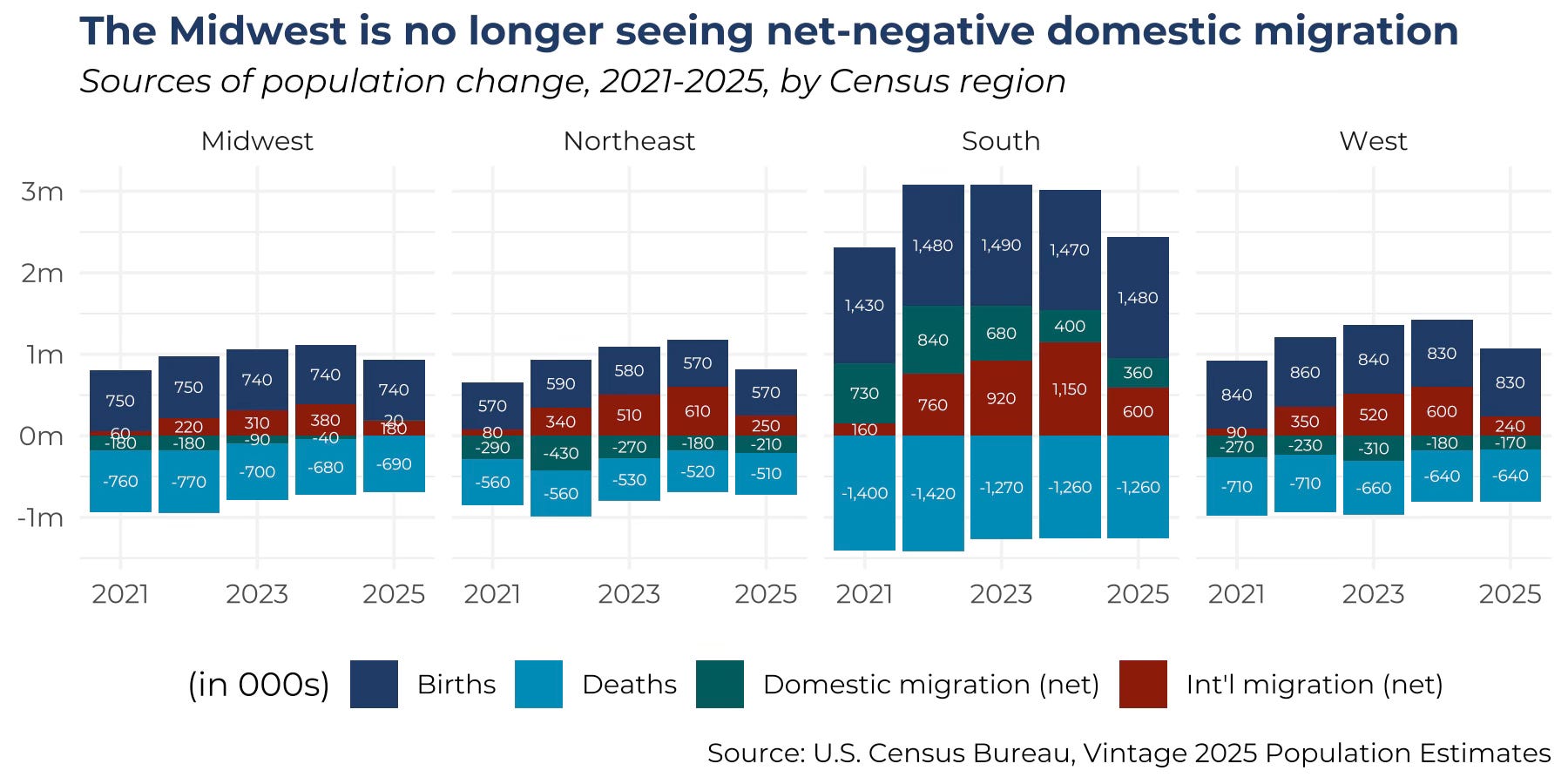
To stress, these are what we might call the ecological conditions for family formation — these data alone can’t say anything about individual fertility rates. But we’re trying to capture “vibes,” not “causality,” so we can plausibly say they suggest where the country sees dynamism, opportunity, and optimism. Let’s strip out international migration, and just focus on the 2025 rates of births and net domestic migration:
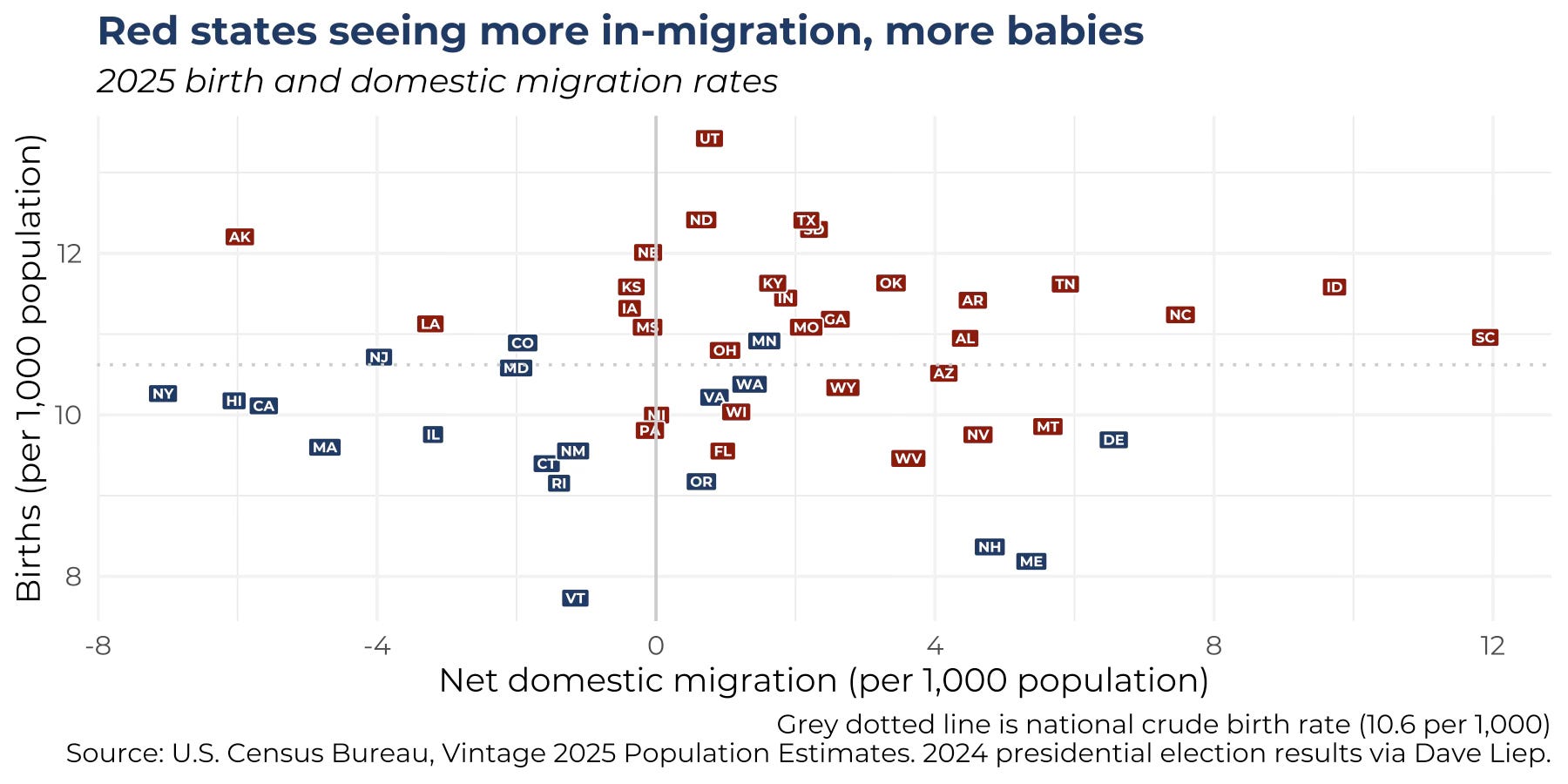
These are expressed in terms of per 1,000 population in the prior year; so for every 1,000 people who had been living in South Carolina, roughly 12 more people moved in from other U.S. states than moved out. States to the right of the grey line attracted more Americans than left in 2025, while those in the negative were net losers. Those above the dashed horizontal saw more babies born than the national average. Which leaves us with seventeen states in the most dynamic, upper right-hand quadrant — those with above average crude birth rates and net positive domestic migration.
Of those, nine are in the South, six in the Midwest, and two are in the West. And all of them, save Minnesota, are red, or at least a dusty rose-ish purple, in political terms. Or, to put it another way, no firmly red state is sitting at below-average fertility and net negative domestic migration. Blue states are hemorrhaging residents and only partially making up for it with international migration, a fact with predictable (though not determinative) political implications.


To illustrate this a little more, let’s compare Tennessee and Massachusetts, two states whose 2020 populations were broadly similar — the Bay State had 7,033,112 residents, while the Volunteer State had 6,912,319. Tennessee took the lead in 2022 and has roared ahead, growing 5.8% during the last five years, while Massachusetts has piddled along at 1.7%. And the source of that growth has varied as well. Massachusetts was seeing higher rates of international migration than births over the past half-decade, while also losing 150,000 residents to other states. Tennessee, on the other hand, was a magnet for blue state refugees, packing in around 280,000 new residents who left other states and adding another 400,000 little bundles wrapped in Volunteer Orange. If you want a model of hope and dynamism, it’s in Nashville, Chattanooga, and Knoxville, particularly if you assume that international migration to the U.S. will remain dampened for the next three years, if not more.
Lastly, we can see where births outweigh deaths — perhaps the most basic metric of population dynamism. Here, the states are ordered in terms of the percentage of natural population change (births minus deaths per 1,000 population). So positive numbers mean more births than deaths, and the seventeen states with negative values (starting with Kentucky and going on over to the right) means they are dying faster than they are having babies:
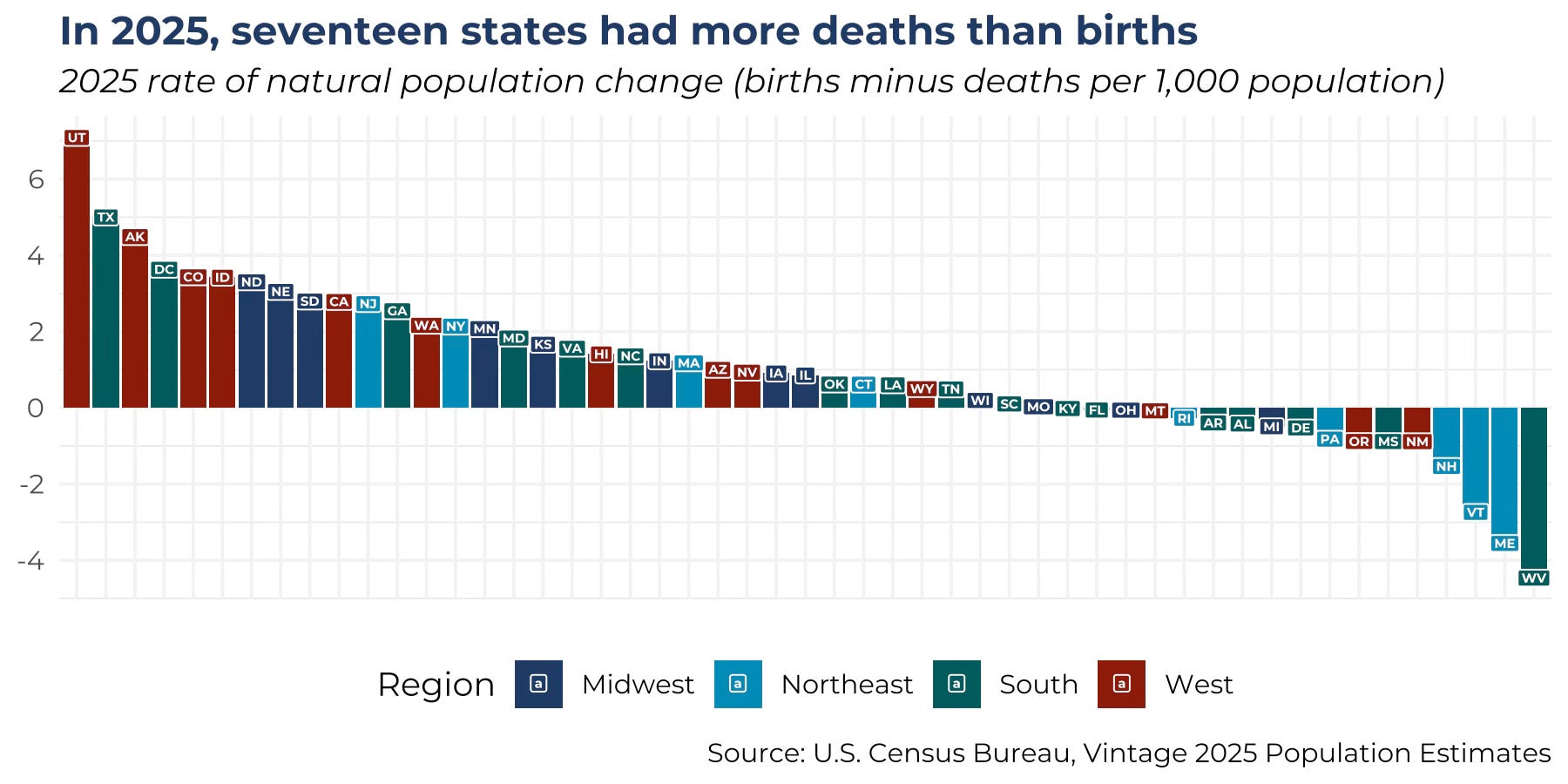
As you can see (especially if you zoom in), some of the retiree-rich red states like Florida are relying heavily on in-migration to balance out their relatively high numbers of deaths. New England and Appalachia have no such luck. If they want to revive their fading demographic fortunes, they will have to think about what is making families choose Sun Belt states over the Rust and Snow Belts.
Are families moving to red states because of low taxes, low cost of living, culture war stances, job flows, or warmer weather? Likely all of the above and then some — an interesting ethnographic project for some aspiring sociologist. Of course red states cannot rest on their laurels, either — they are far from immune from the same market pressures and bad zoning policies that made blue metro areas so expensive as to chase out families. Red state hot spots like Atlanta, Austin, Nashville, and Miami are developing their own pathologies, the result of having too many people chasing too little housing. The time to get ahead of your cost of living crunch is before it becomes a crisis.
And that is why I am so incredibly excited to see the American Housing Corporation’s debut onto the scene.3 Founded by Bobby Fijan, a real estate developer and long-time evangelist for more family-friendly housing units, William Davis (better known by his nom de X, @YIMBYLAND), SpaceX alum Riley Miek, and software engineer Harris Rothaermel, the company spies a policy failure that could become a market opportunity. It is easier for developers to churn out studio apartments or greenfield suburban subdivisions than it is to address the so-called “missing middle” — townhomes, rowhouses, and other, denser forms of living that are neither high-rise nor detached single-family. In many cities, building those units is cost-prohibitive (when it’s not outright illegal thanks to zoning codes and overlays.)
AHC seeks to overcome this by specializing in pre-fabricated elements which are assembled on-site to innovate past some of the fixed costs associated with urban in-fill housing. They claim to be the first company to be vertically integrating “technology, manufacturing, and real estate” under one roof, allowing them to focus on their distinctive vision — providing “modular homes optimized for families” with the aim of creating “thriving neighborhoods where families can grow, find opportunity, and build community.”
In an age where “innovation” too often means SaaS/B2B/crypto/blockchain bits and bytes, it is so refreshing and enlivening to see a new entrepreneurial company dedicated to building housing for families. If you can’t read their mission statement and feel a surge of pride and hope that they’re able to successfully bring their vision to market and find a robust demand for it, you aren’t going to make it. Pre-fabricated housing, or the YIMBY reforms necessary to legalize other family-friendly housing types, won’t solve blue states’ problem of population exodus single-handedly, nor will it guarantee that red states stay affordable. But it will certainly help! And it’s a heck of a lot more attractive than either zero-sum thinking or resigning oneself to a future of stagnation and decay.
Public Works, Public Beauty
Speaking of attractiveness, innovation, and inspiration, good news from the Department of Transportation — Justin Shubow, president of the National Civic Art Society and an influential voice advocating for more beautiful civic spaces, has been named the inaugural chair of the recently-established Beautifying Transportation Infrastructure Council.
The council has been “charged with advising the Secretary of Transportation on enhancing the aesthetic value of our Nation’s transportation systems and provides recommendations on policies, designs, and funding priorities that beautify transportation infrastructure, including highways, bridges, and transit hubs, while maintaining safety and efficiency.”


Sometimes the push for more attention to beauty and composition of our public architecture can fall into RETVRN-brained slop. Shubow’s selection is a sign that Secretary Sean Duffy is avoiding mere sentimentality. Note the four examples highlighted in Shubow’s tweet and statement; not just the grandeur of Cincinnati’s Union Terminal and its Art Deco-inspired4 contemporary, the Golden Gate Bridge, but George Dunkelberger’s Art Moderne bridges on the Merritt Parkway in Connecticut and the sweeping Space Age elegance of Eero Saarinen’s Dulles terminal. Any public works built in a contemporary American vernacular can look to these archetypes for inspiration.
This goes beyond slapping some gold filigree or Doric columns on a blueprint and calling it a day. It’s a commitment to taking the role that public spaces can play in building community and inspiring the soul seriously; as Shubow says, “Beauty in design must not be an afterthought, dismissed as an alleged luxury or anachronism in the name of pure functionalism.” (Shubow also has visions of a grand plan to replace the decrepit Brutalist skull that is the nearly-empty James V. Forrestal Department of Energy building with an expansive (and expensive) grand promenade connecting the National Mall to the Washington D.C.’s newly revived southeastern Waterfront.)
Secretary Duffy continues to rack up wins, ranging from the cosmetic to the meaningful. When he announced the formation of the council, Duffy asked “What happened to our country’s proud tradition of building great, big, beautiful things?” The “Abundance” movement has been broadly successful at driving home the shocking reality landmarks like the Golden Gate Bridge (four years) and the Empire State Building (one year and 45 days) were built faster than it takes to complete a preliminary environmental review today. A conservative rejoinder might consist of a “yes, and”; not just building more infrastructure (and housing) more quickly, but building it with an eye towards reflecting “our nation’s strength, pride, and promise.” We will watch the Council’s work with great interest.
It’s Me, Hi
The Colorado Times Reporter quotes me in their coverage of the National Pro-Life Summit:
“If we’re not able to make converts, we’re going to lose,” said Patrick Brown, from the Christian think-tank [sic] the Ethics and Public Policy Center. “As we’ve seen in the last three years since the Dobbs decision, public opinion is not with us on the question of abortion, per se…
“We march every January in Washington, D.C., because the people who we march for can’t march for themselves, and we witness on behalf of the unborn. Babies don’t vote — but seniors do — and seniors get a lot of attention from politicians.”

In his news analysis piece for the National Catholic Register covering Vice President JD Vance’s speech at the March for Life, Jonathan Liedl cites my work around pro-family policy:
“As Ethics and Public Policy Center fellow Patrick Brown has already argued, restricting the abortion pill and pursuing pro-family policies like a “baby bonus” can and should be pursued at the same time. The Trump administration’s pursuit of some “Pro-Life 3.0”-type policies doesn’t seem to justify scrapping the kinds of legal restrictions employed by previous versions of pro-life advocacy.”
DrugTopics quoted my assessment of the fractures between the pro-life movement and the Trump administration in their coverage of the abortion pill debate:
“There’s definitely some ill feeling…Pro-lifers feel the sense that Trump is happy to let them go separate ways.”
Parting Shots
Daniel Cox, Charles Fain Lehman, Richard V Reeves, and Christine Emba will be on a panel entitled “Male Vice in an Internet Age” next Tuesday, February 3, at the American Enterprise Institute
A new report from Common Sense Media finds that more than one-third of boys have participated in online gambling prior to turning 18
The House passed the Supporting Pregnant and Parenting Women and Families Act (H.R. 6945), a bill that would confirm that pregnancy resource centers are eligible to receive funding under the Temporary Assistance for Needy Families program
In testimony before a House Oversight subcommittee, Ed Pinto offers some ideas for incentivizing turning over more housing stock and creatively expanding housing finance options, such as increasing the cap on capital gains
For his Substack, Empirical Questions, Robert VerBruggen examines the claim that declining fertility will be compensated by delayed fertility: “Fertility is going down and 40-year-old women are not about to start popping out tons of kids to stop it.”
Maria Baer and W. Bradford Wilcox warn Republicans that Democrats may be outflanking them when it comes to responding to parents’ concerns around AI (Family Studies)
Last year, the Washington state legislature voted to remove parental access to student medical records. An initiative seeking to overturn that change, as well as one prohibiting transgender students who were born as male from competing in high school girls’ sports, will be facing Washington voters on the ballot later this year.
Michigan is launching an expanded child care cost-sharing program entitled “CareShare,” where employers will cover one-third of child care expenses and employees will pick up the remaining two-thirds (firms will save on administrative expenses). It’s available to households between 200 and 325 percent of the federal poverty line — a bigger pool than the existing Tri-Share program.
Also in Michigan, the state cut $19 million that went to child care resource collaboratives. And, separately, state Senate Republican Leader Sen. Aric Nesbitt called for an audit of the state’s child care subsidy program.
In New York, state senators highlighted state Sen. Jacob Ashby’s proposed legislation that would create a $1,000 refundable tax credit for new parents.
The happy staging of post-delivery photos with parents who have contracted with a surrogate can’t disguise what has been taken from the children, writes my EPPC colleague Carl Truman for World.
A new coalition of social conservative organizations is trying to lay the groundwork for a revisiting of the Obergefell decision that redefined marriage to include same-sex couples.
Ivana Greco and Elliot Haspel find that a large share of parents with a stay-at-home parent have at least some child care expenses (Capita)
Comments and criticism both welcome, albeit not quite equally; send me a postcard, drop me a line, and then sign up for more content and analysis from EPPC scholars.
Essentially, the Census Bureau is taking their estimates of how many people live in a given jurisdiction, and backing out birth, death, and migration estimates (methodology here, for the curious). The exact number of births in a state will come later, from the CDC via state vital records agencies, but who has time to wait around.
In the four years from 2021 to 2025, the fastest relative growth has been in Florida, South Carolina, Texas, Idaho, and North Carolina, which all have seen their population grow by 5.9% or more during that time. Meanwhile, population growth over that stretch has been essentially flat or negative (.05% growth or lower) for Oregon, New Mexico, Alaska, Pennsylvania, Mississippi, Illinois, Louisiana, Vermont, Hawaii, and West Virginia.
It’s a small thing, but the company name alone gives me hope that we are entering a new era of American innovation. Ten years ago, they would have been forced to adopt some cutesy, jargony mouthful — buildr, WeHouse, Pied Piper. But the American Housing Corporation just screams mid-century excellence and stability, like it does exactly what it says on the tin. More, please.
The unquestionable peak of American design, it must be stated for the record.
The big reason I think the sunbelt keeps growing is universal school vouchers. They were important to my move. And it’s a housing issue. As long as schools and housing are linked assets, zoning is inevitable and justified.
I would also note that in state tuition at university of Florida is around 75% cheaper then my old state if your middle class and above.
As to abortion and child bonuses, I’m pro-life and pro-ctc but if I had to choose between the two I’d prioritize CTC over anti-abortion. It’s easier to convince people to have babies by changing their incentives than to force them to have kids they don’t want.