


The Seattle Mariners are the only active Major League Baseball franchise never to have played in a World Series. In order for that to change, they have to win two of the next three games. Canadians, beware — If it’s Friday, it’s Family Matters:
IVF Update: Assessing the White House’s announcement on fertility
Mama’s Got the Pill: Is there a measurable shift towards holistic fertility awareness?
Parting Shots
IVF Update
We’ll get to today’s featured essay in a moment, but first some late-developing news. The White House released its much-anticipated guidance on expanding access to in vitro fertilization yesterday, and it’s clear that they took the concerns of the pro-life movement seriously.
Consider, for a moment, how this whole policy debate transpired. In August 2024, Trump told a town hall audience that “the government is going to pay for it, or we’re going to get — we’ll mandate your insurance company to pay for it, which is going to be great.” In an interview with NBC News, he said that “We’re going to be, under the Trump administration, we are going to be paying for that [IVF] treatment, or we’re going to be mandating that the insurance company pay.” In February, the White House released an executive order with the goal of “protecting IVF access and aggressively reducing out-of-pocket and health plan costs for IVF treatment.”
Yesterday’s announcement does not mandate IVF coverage through insurers, nor does it expand public funding for IVF. Instead, it offers a handshake deal with drug manufactures to lower prices on the drugs used during fertility treatment, much as the administration has pursued on other medications. It also offer guidance to health insurers to create stand-alone insurance products for infertility coverage, in the same way that vision and dental stand outside the normal suite of health insurance coverage. Many pro-lifers have criticized this step for expanding access to infertility services they rightfully consider to be morally fraught and ethically challenging. Yet the sizzle of the rhetoric (“I know what you’re all thinking — and you’re probably right — there’s going to be a lot of Trump babies,” said Centers for Medicare and Medicaid Services Administrator Mehmet Oz) doesn’t match the steak of the apparent plan.
There is nothing in regulation currently stopping firms from offering insurance coverage of infertility treatments, but few do (only about a quarter of the bigger health insurance plans); not because they are barred from doing so, but because it is incredibly expensive.1 In a market with heavy adverse selection, the premiums will likely rise to something near the actual cost of the service. Without additional subsidies or mandates, it’s unclear how add-on “insurance” for infertility will actuarially improve access — are there that many employees eager to pay expensive premiums for a service they know they are unlikely to use, or no longer have need of? There may be some efficiencies to be gained by streamlining administrative regulations but IVF and related fertility treatments will remain costly procedures for the foreseeable future, until Silicon Valley’s increasing investment into biotech successfully “hacks” reproduction on some mass scale.2
EPPC President Ryan T. Anderson has longer, fuller, and likely better thoughts at First Things magazine, calling it “the least bad that we could have hoped for…but least bad is still bad.” I will build off his remarks to make one final point: Pro-life conservatives have a lot of work to do to make the moral case that the fertility industry needs better regulation, rather than a blank check. Yet the fact that the White House took their (our) concerns seriously enough to draft regulations that respect their concerns seriously reflects something important.
Despite the prognostications of some (me), who worried that Trump’s waffling on pro-life issues during the campaign signaled the beginning of the end of the pro-life movement’s influence on Republican politics or the MAGA movement, the guidance suggests pro-lifers still have friends in high places. Working within the confines of the President’s rhetoric on the trail, the White House was able produce a document avoids the pitfalls, in less able hands, that could have been one of the most aggressively unfriendly steps towards religious conservatives ever undertaken from the executive branch. For that, social conservatives should be grateful, and claim some measure of victory; and then get to work making the broader case that IVF as often practiced in the U.S. will not, actually, raise birth rates, will open the door further to eugenics, and, ultimately, will usher in the greater instrumentalization of human life.
Mama’s Got the Pill
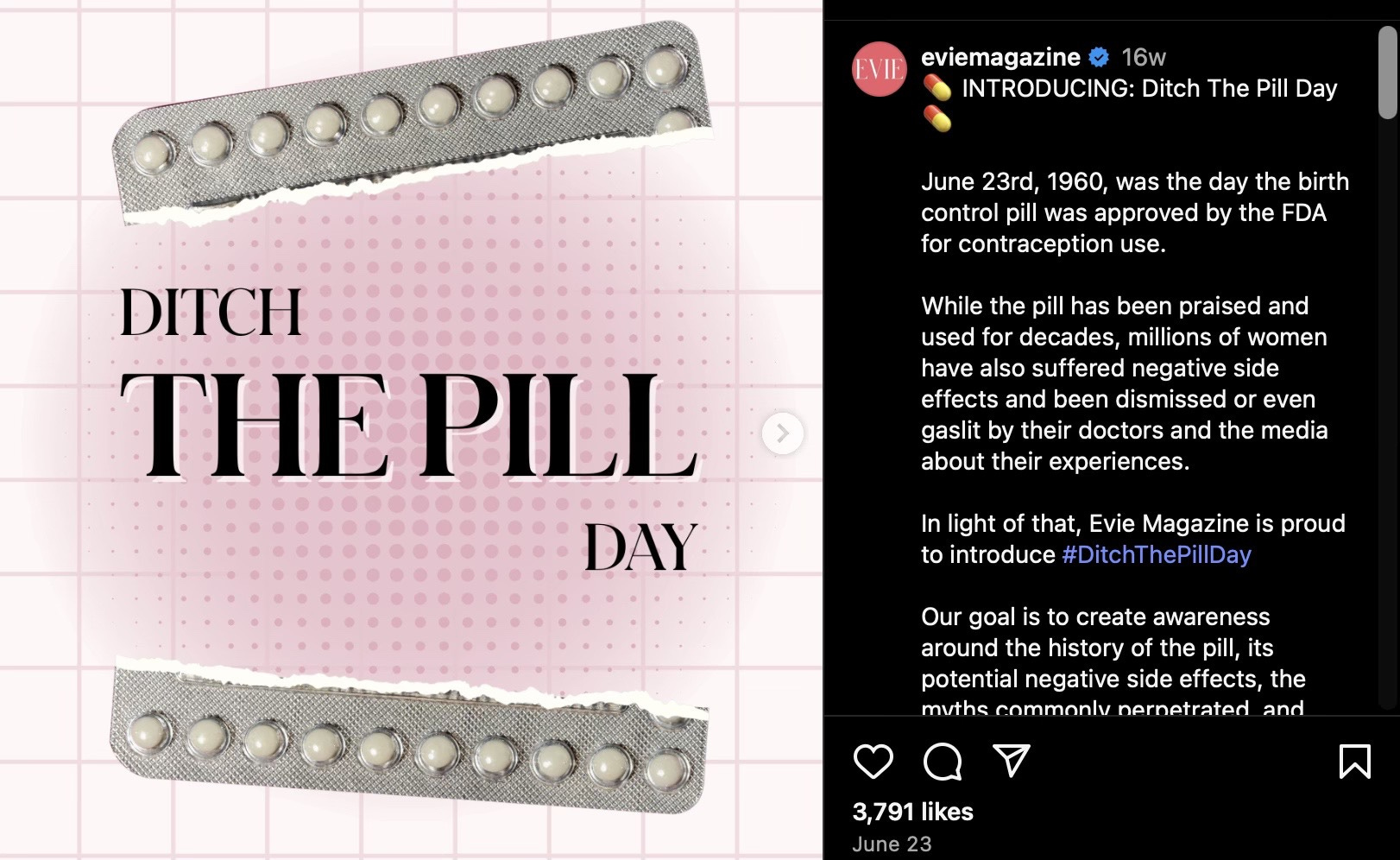
There has been a continuous stream of trend pieces over recent years about women turning away from the birth control pill. A very brief representative sampling can be found in the New York Times, Oprah magazine, Vogue, the BBC, The Cut, the Washington Post, the New York Post, and Evie magazine, which took it upon itself to launch “Ditch the Pill Day” earlier this year.
There’s been a lot of huffing and puffing about various TikTok videos or influencers that purportedly spread misinformation about the health risks of the contraceptive pill, as well as some hopeful prognostication from conservative writers that women are turning away from the pill to embrace more natural forms of monitoring their fertility and adopting aspects of a conservative worldview when it comes to sexuality and parenthood. As Jennifer Gerson and Mariel Padilla reported for The 19th, there is at least some suggestive evidence online for a kind of “MAGA to MAHA” pathway, with young women taking the potential of holistic approaches to fertility seriously, and looking for more organic, all-natural, and non-hormonal ways of treating all sorts of health and wellness conditions, including managing their fertility.
So, how about it? Does the most recent available national data show more women dropping the Pill en masse to pick up more naturalistic ways of family planning? The short answer is that…we can’t say for sure, but it doesn’t really appear to be happening.
Due to some unfortunate methodology shifts, partly due to Covid, the findings in the most recent National Survey of Family Growth aren’t directly comparable to previous survey years.3 The 2022-2023 NSFG finds that 11.4% of women age 15-49 are currently using the contraceptive pill (45.8% of females in this demographic report not currently using contraception, whether because they are not sexually active, pregnant, or seeking to become pregnant.)
If we directly ignore the CDC’s extremely explicit instructions about not comparing the post-Covid survey wave to prior years, we might see this as evidence for the claim that women are getting off the birth control pill to pursue more natural or holistic methods of fertility management. The 2017-2019 NSFG found that 14% of women were using the contraceptive pill, down a few ticks from the 16% recorded in the 2011-2013 NSFG. Even if we mentally account for the apparent methodological irregularities, the 2022-2023 NSFG seems to confirm a gradual slide away from the pill.
But what are they shifting towards? About 2% of women who are trying to avoid becoming pregnant are opting for fertility awareness-based methods of avoiding pregnancy, roughly in line with the last few surveys (again, taking care not to compare them directly). Note that this doesn’t mean that only 2% of women are using holistic fertility awareness methods. Many of them may be accounted for in the 16.4% of women who describe themselves as not using contraception, or are pregnant, postpartum, or trying to conceive. But even with those caveats, these approaches remain, essentially, a rounding error. There is little statistical evidence, to date, of a statistically perceptible shift towards the kind of holistic fertility awareness that influencers and commentators on the right would like to see taking hold.4
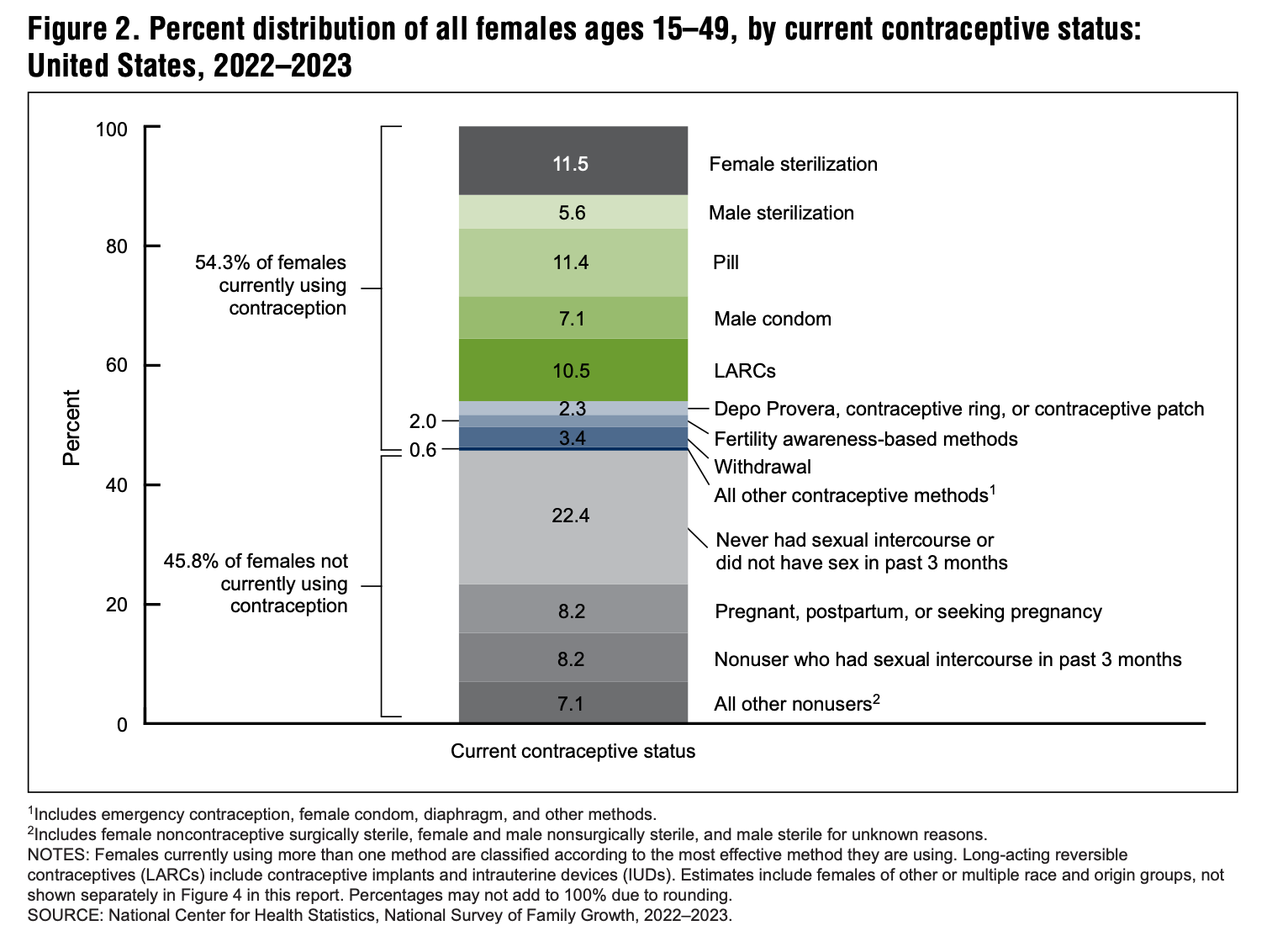
Among women who are currently using contraception, female sterilization and long-acting reversible contraceptive devices have become essentially as common as the pill (this was true in the most recent survey wave prior to 2022 as well.) The (apparent) decline of the popularity of the pill doesn’t seem to reflect a greater suspicion of artificial interventions to reduce the chance of pregnancy, nor a rise in desired fertility, but a shift towards techniques that are less susceptible to potential user error and more reliably shift the female fertility default towards “off.”
For more suggestive evidence we can turn to our friends across the pond. The U.K. has, in some ways, had an uprising of sex-realist feminism that has outpaced the U.S., with British writers like Mary Harrington and Louise Perry building large followings among women unsatisfied with the answers being provided from mainstream sources. We might expect that if there was a backlash against the pill and in favor of more natural, holistic approaches to sex and fertility, we might see evidence for it in the fact that oral contraceptive use among British women appears to have declined from 19% to 11% from 2018 to 2023 . Yet that story, too, largely reflects a shift in the type of contraception used.
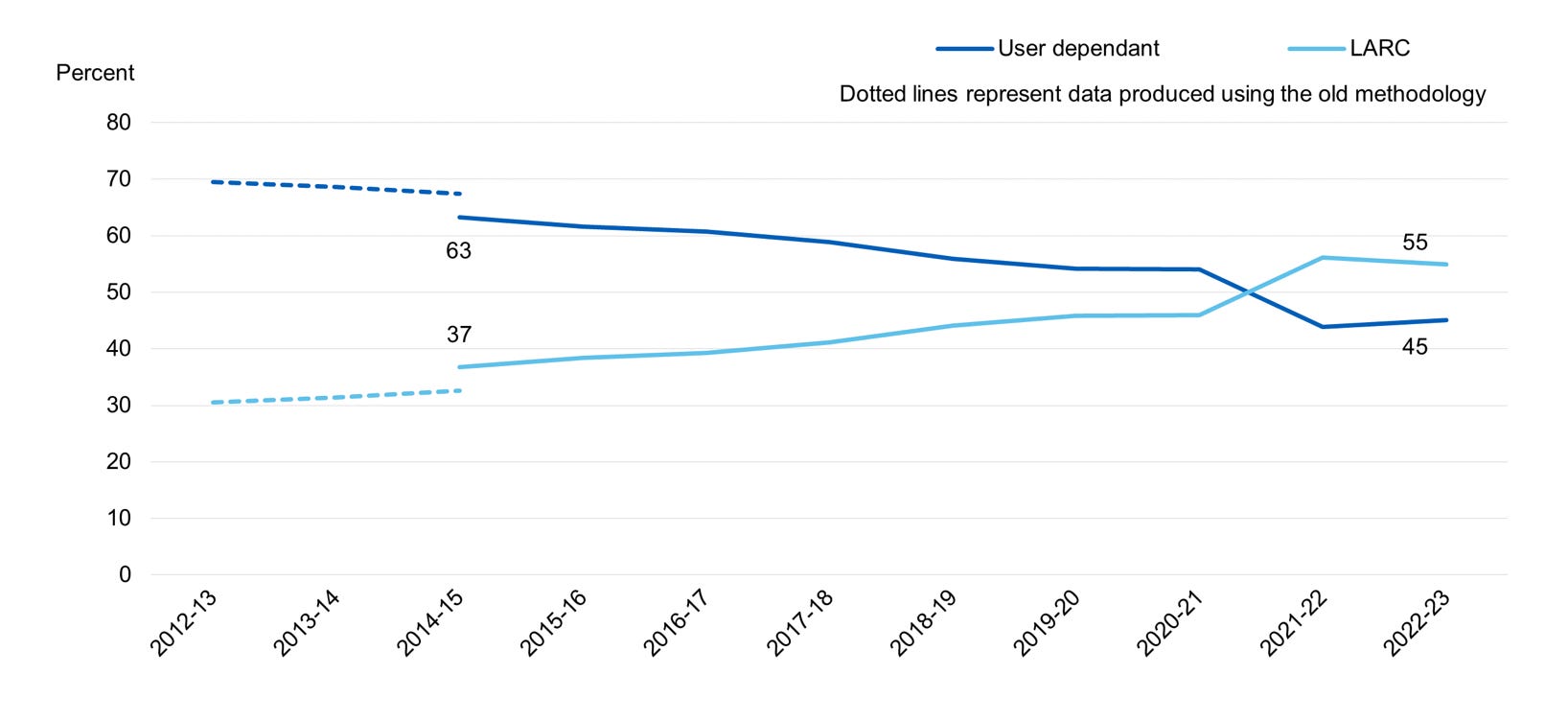
UK women appear to be making the same shift away from “user dependent” methods (i.e., the contraceptive pill or other methods that rely on the user proactively taking steps to avoid pregnancy) and towards LARCs. In 2019, the British government expanded its policy of encouraging women to opt for LARCs, to “reduce unintended pregnancy and be most cost-effective for the NHS.” (Part of the reason for the abrupt drop in 2021 in the “user dependent” methods is that the pill became available over-the-counter, which means some users won’t show up in this database of claims, but the pre-trend is pretty visible either way.)
In sum, there’s decent evidence the claim that women may indeed be shifting away from the contraceptive pill, but less for the claim that they are adopting holistic, fertility-awareness based methods of family planning. Why might it feel that way? Remember that there 74,937,000 (or so) women age 15-49 in the United States, and 45.8% of them (per the less-than-reliable 2022-2023 NSFG) are not currently using contraception.) That means 162,000 women could switch from using the pill to holistic birth control methods to avoid pregnancy, post TikTok videos and create a flood of trend pieces, and it would still fail to show up as even a statistical blip in the data. Instead, what we do see in the survey records is evidence of a cultural shift towards permanent or semi-permanent forms of birth control.
One addendum, on a more speculative note: “Set it and forget it” methods of contraception treat the choice to have a child as binary: it’s either going to be intentionally planned and scheduled, or it will be avoided. That’s how a lot of professional-class individuals think about childbearing, and how a lot of public health institutions do as well. Yet that binary choice of “intentional” or “unintentional” doesn’t reflect reality for many. The Guttmacher Institute, in fact, published a piece in the late 1990s that the binary understanding of “planned” or “unplanned” should be thought of as more of a continuum, and many of the sex-realist writers who write for outlets like Fairer Disputations have also written about the act of having a child as something different than strictly a rational assessment of economic costs and benefits. Moving our discussions around fertility beyond a binary choice between “planned” and “unplanned” pregnancy to a place that respects the messier reality and complicated feelings many people have towards expecting and becoming a parent would be beneficial for discussions about fertility and the birth rate.
Parting Shots
EPPC Visiting Fellow Rachel Roth Aldhizer will be on a panel on gene editing and embryo screening being hosted by the Heritage Foundation on Wed., November 5 in D.C.
Elliot Haspel reports that Oregon lawmakers recently cut 10% from its state-funded pre-K system for low- to moderate-income families, and other states, including progressive bastions like Colorado, Maryland, and New Jersey, have also frozen spending to help address budgetary pressures (The 74)
Aria Bendix reports that despite the No Surprises Act and other health care expansions, some families on high-deductible health plans are faced with very high hospital bills after childbirth, especially in the wake of complicated or high-risk deliveries (NBC News)
Gabe Kaminsky and Tanner Nau investigate the industry players seeking to convince the Trump administration to reschedule marijuana — a decision is likely by the end of the year (The Free Press)
Claire Cain Miller and Amy Fan report that 97 percent of teenage boys play online games, spending an average of 10 hours a week on them: “Boys would rather sit in front of Minecraft or Fortnite than play outside,” says a teacher in Portland, Maine (New York Times)
California Gov. Gavin Newsom signed a bill streamlining regulations for free-standing birth centers, allowing pregnant woman who don’t want to deliver in a traditional hospital environment more options (CalMatters)
Comments and criticism both welcome, albeit not quite equally; send me a postcard, drop me a line, and then sign up for more content and analysis from EPPC scholars.
In nine states plus DC, state law requires coverage of IVF, and four more require large group plans to cover it.
Something we should, at the very least, seek to debate or ideally regulate, rather than subsidize!
The CDC basically throws up a big red flag for anyone trying to compare the 2022-2023 NSFG to previous survey years: “Data users are encouraged to exercise caution when making comparisons to prior years of data collection and interpreting any differences….Users are advised to note the design-related changes, particularly with regard to mode, if making statements comparing earlier estimates to those from 2022-2023” (page 17). Consider them noted! Lyman Stone also walked through some of his technical adjustments at his Substack.
Caveat that the survey wave ended in 2023, before some of the most high-profile MAHA critiques of the contraceptive pill had fully permeated the ecosphere. It is possible that the attention to holistic health care driven by HHS Secretary Robert F. Kennedy, Jr.’s presidential bid, and the subsequent allying with the Trump campaign, helped change these trends after the survey work was completed.
With regard to "Moving our discussions around fertility beyond a binary choice between 'planned' and 'unplanned' pregnancy to a place that respects the messier reality and complicated feelings many people have towards expecting and becoming a parent," numerous papers have been written about this during the past 40 years, but as long as we are beholden to the same survey instruments, we're pretty much stuck with the binary distinction.
Back in May, I also wrote about the questionable results from the 2022-2023 NSFG: https://borncurious.blog/p/survey-quality-is-declining-because
If you are having sex without reliable contraception, you are “trying” to get pregnant.