

Avoiding Deadweight Loss
Many of the headwinds facing the GOP this fall are self-inflicted

Let’s hear it for Lewis Kalb, a 73-year-old substitute teacher from Medford Lakes, N.J., who won an auction held by the Philadelphia Phillies to join the team’s radio booth for an inning. He made the most of his opportunity, and then some. If it’s Friday, it’s Family Matters:
Can Republicans Ditch Tariffs?: Evaluating the political and economic case for tariffs
Qui Custodiet?: The culture of “optimization” comes for the nursery
This Budd’s For You: Standing up to the pot industry and its backers
It’s Me, Hi: Letter to Senate Commerce
Parting Shots
Can Republicans Ditch Tariffs?
If you look at the trend of President Trump’s polling average, as compiled by Matthew Yglesias, you can see a couple distinct moments in his second term where the elevator dropped a few floors. The initial highs of the second inauguration were almost immediately undermined by DOGE’s antics, though that coincided with an expected reversion to the mean following the post-election honeymoon. Then, in April, a sharp dip from “Liberation Day,” followed by a recovery as the most dramatic of the tariffs were rescinded. In late 2025, ICE’s aggressive enforcement tactics and the fatal shootings in Minneapolis led to another drop, as the opening of hostilities against Iran in the spring.1
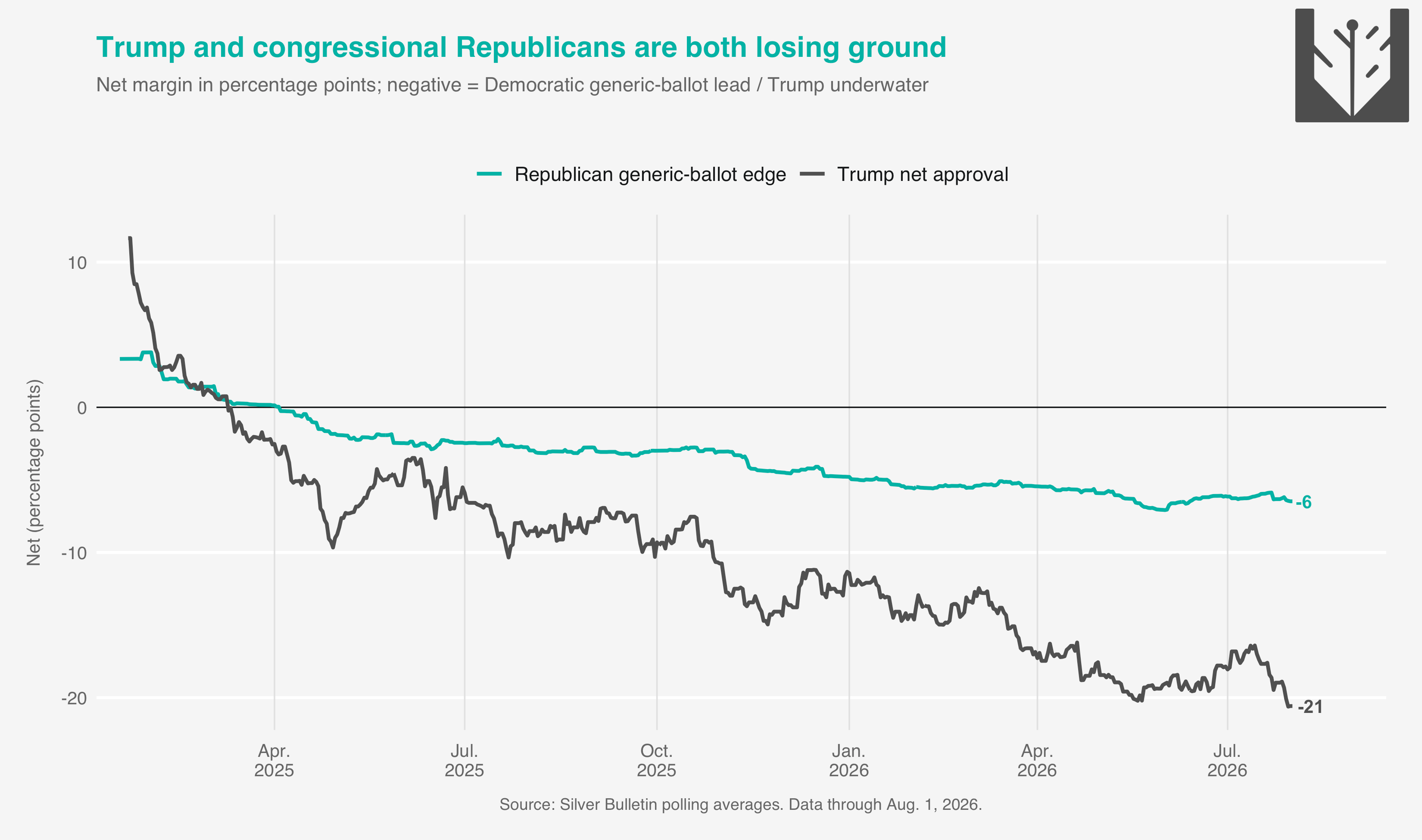
The Trump administration seemed to have pulled the reins back on the shock-and-awe immigration approach following the blowback they received over the winter. The on-again, off-again attempts at a ceasefire in the Persian Gulf suggest they know that there, too, public opinion is not convinced by the argument that “we have always been at war with Iran.”
Then there’s the tariff regime, which, by all accounts, the President comes by his affection for honestly. In his 2011 book teasing a potential Presidential campaign, “Time to Get Tough: Making America #1 Again!,” Donald Trump proposed a version of his across-the-board tariffs that would come to characterize the initial Liberation Day attempts: “So here’s the deal: any foreign country shipping goods into the United States pays a 20 percent tax. If they want a piece of the American market, they’re going to pay for it. No more free admission into the biggest show in town—and that especially includes China.” For a politician who has proven deft at weaving between his various political commitments and stances, his belief in tariffs is earnest and long-standing.

The problem for the President is that having gotten a taste of what heavy tariffs do to the economy over the short-run, the American people have decided they find it unappetizing. As Nate Silver and Eli McKown-Dawson talked about in their Silver Bulletin update earlier this month, “People really do not like tariffs. Liberation Day was the first big drop we had in the average, very early on, and tariffs are also now popping back up…I think if you asked the White House, they’d say, ‘Well, sure, people aren’t happy about the economy, it’s not fantastic, but we can kind of win them back with cultural grievance type issues.’ And it’s kind of almost the reverse, if anything.”
Politically, Republicans aspiring for Congress in competitive states or districts could probably make some headway by creating daylight on the tariff issue. “President Trump has been tirelessly trying new approaches to create good-paying jobs, which I fully support, but given the rising cost of everything, we have to pull out all the stops to bring down the cost of living and get rid of some of these tariffs.”
Some of the more true believers will still try to make the long-term case for the tariffs, arguing that due to the Supreme Court’s decisions or other exigencies the tariffs need to be given more time to take effect and truly usher in the Golden Age which has oft been promised. The steel-man case for a rethinking of free trade remains something like accepting the trade-off between lower consumer prices and the need to make supply chains more resilient, boost industries critical for national defense, or even just to shake up a sometimes sclerotic global status quo.
But a little over a year since “Liberation Day” and its aftermath, it’s worth spending a little time thinking about the costs and benefits of our new semi-tariffed kind of life. A symposium in the latest issue of the Journal of Economic Perspectives analyzes the impact of the Trump II Tariff Regime from a number of different angles — and what they suggest is less “a worthwhile idea implemented haphazardly” than “a trade-off whose costs outweigh the benefits.”
One paper, by Harvard’s Gita Gopinath and U-Chicago’s Brent Neiman, finds an exceptionally high pass-through rate of 92 percent for the 2025 tariffs — that is, for every dollar of tariff imposed, the price paid by U.S. importers rose by 92 cents, which subsequently gets passed through supply chains onto downstream firms and consumers.2 (“When a 10 percent tariff is imposed on an imported good, US importers appear to pay 8–10 percent more, including the tariff, for that good.”) They are careful to note that statutory rates often overstate the actual average tariff rate, and do their best to account for that in their paper. Once they make those adjustments, they find that foreign exporters are eating a very small share of the post-tariff price, with most of the increased cost passed on to American firms and consumers.
What did this do to household pocketbooks? The Tax Foundation’s Kyle Pomerleau and Erica York look at the distributional impact and find that “tariffs are regressive: the tax burden as a share of (pre-tariff) after-tax income is higher for low- to middle-income households than for high-income households.” This isn’t surprising if you imagine a family on the lower half of the income spectrum as buying a higher share of trade-exposed and imported goods than higher-income families who purchase relatively more services and non-tradable goods (think a family who shops at Walmart vs. the upscale boutique).
Of course, the intellectually honest defense of the tariffs is to acknowledge that yes, consumer prices will go up, at least until domestic producers shift their practices, but it’s worth paying that cost because of the benefits to workers. We need an economy, we hear, that is optimized for higher wages for workers in American manufacturing and less around cheap consumer goods and services. Rafael Dix-Carneiro and Brian K. Kovak review the evidence for that claim in a more theoretical paper and suggest there’s no guarantee that tariffs will lead to better labor market outcomes: “protecting industries may benefit firm owners without necessarily benefiting workers.”
They point to a 2024 paper from the authors behind the initial “China Shock” work, which found that while domestic industries that benefited from tariffs did see an increase in sales, that did not translate to a statistically-significant increase in employment. It’s not that a tariff regime couldn’t theoretically boost the blue-collar labor market, in other words — it’s just that we should only expect any benefits to accrue to workers over the long-run, after firms and industries adjust to the new terms of competition. And the most recent job numbers suggest a weaker labor market is not in the position to bear such experimentation for long.
All that is cold comfort for all those tweeting about $20 burritos, and their sense that an administration elected to bring down the rising cost of living has instead pursued actions that are making the affordability crisis (or, “crisis”?) worse. Like the Iran war, our new tariff regime has relied on and been undermined by an extremely high degree of executive fiat and accompanying unpredictability, and characterized from the outset by a lack of clear communication around the trade-offs necessary to reach a particular goal.
The President will continue to make his case — with two years left in office and decades’ worth of commitment to the idea, he’s not going to be talked out of it now. In some respects, his flat 20% universal tariff idea from 2011 would at least be more predictable and consistent than the current ping-pong ball approach.
But Republicans running for office this fall need not tie themselves to the mast of a policy that is creating economic headwinds and failing to produce any political benefits. Creating strategic space from the mishandling of the tariffs — just as with the Iran war and the overzealous immigration enforcement — can help Republicans tack to the center and focus on what voters are most worried about. Far better to come up with ideas that take on the sense the cost of living is skyrocketing by expanding the economy’s productive capacity and removing supply-side constraints on key goods like housing and health care — and better yet, to mean it.
Quis Custodiet?
The team over at the American Compass Substack, Commonplace, recently published a roundtable on the dynamics of parenting, pegged to Sapna Maheshwari’s New York Times piece on high-tech parenting, under the absolutely fantastic title “But Who Monitors the Baby Monitors?”:

In the discussion, the new parents on the Compass team (mazel tov!) talk about their ambivalence, or outright unease, at the new trend of “hypervigilant” baby monitors — the $300 socks offering pulse oximetry tracking, the $359 baby monitor that promises “A.I. scheduled lullabies,” the $120 app membership that purports to offer “optimized nap predictions,”3 and the rest. It’s an industry perfectly calibrated to capitalize on the natural sense of “I don’t know what I’m doing” that every new parent experiences with the tech-empowered neuroticism of a generation habituated to obsessively track their Apple Watch sleep score.
As Abigail Ball, Compass’ executive director, points out:
“It’s a glide path. You have to choose intentionally to seek out a different option like a low-tech baby monitor and be able to answer the question implicit in the marketing: why don’t you want the best for your baby?”
This question is at the heart of so many modern parenting trends, whether it be the $40 billion youth sports industry or the growing push for embryo optimization coming from Silicon Valley startups. “Why don’t you want what’s best for your future baby? Your toddler? Your 11-year-old shortstop? Don’t you know other parents are going to pay to ensure their children are going to have the highest IQ, the most high-enrichment early learning environment, the private tutor?” Whether it’s cause or effect of a low-fertility future (I suspect it’s a little bit of both — if parenting requires that level of intentionality and investment it’s hard to justify more than one or two), that mentality, and the tech that enables it, are embracing a view of human nature that sees it as something to be optimized, hacked, and improved upon. Yet what’s sold as peace of mind ends up creating neuroses of its own. (For more on a related theme, see Clay Routledge’s recent New York Times opinion piece on the “pathologizing” of ordinary life.)
There’s less a legal or political prescription one here than a cultural one — opt out of the culture of optimization and pursue a soft boycott of these types of goods until such time as our politics is ready for a hard one. If you find yourself contemplating whether you need an app to tell you whether you need to read your kid more books at bedtime, give yourself the gift of opting out and pick up “Goodnight Moon” instead.
As a reminder — only paid subscribers are able to comment on Family Matters posts. Subscribe today to give yourself not just the phenomenal cosmic power of being able to comment, but the warm glow of supporting high-quality family policy writing.
This Budd’s For You
Lastly this week, Sen. Ted Budd (R-N.C.) deserves a public shout-out for his work to uphold Congress’ intent in passing a law to ban hemp-derived cannabis last year, despite White House-led efforts to delay the date the restriction is scheduled to take effect.
As I wrote for COMPACT magazine at the time of the original ban, “While hemp is generally less potent than marijuana, it contains the same intoxicating chemical—tetrahydrocannabinol, or THC. By using hemp to extract and create synthetic THC, companies [can] create products that contain even more highly concentrated substances than even natural marijuana could produce.” Last year, Congress voted to restrict the practice, recognizing that the loophole had, in effect, created an ersatz national legalization of some marijuana derivatives, often in packaging meant to appeal to kids and teens. The pot industry has been pulling out the stops to delay and ultimately repeal the legal limitation, and got President Trump to successfully petition Senate negotiators to include a delay in the government funding package being debated.
As the New York Times reported, “Complicating matters further is that the delay stands to benefit the son-in-law of Susie Wiles, Mr. Trump’s chief of staff. The animosity flared on Wednesday during a closed-door luncheon of G.O.P. senators, where James Braid, Mr. Trump’s legislative affairs chief, made the case for the provision and promised opponents that the White House would not seek any further postponements.”
It takes courage to stand against one’s political opponents on behalf of what’s right; it takes even more to stand against one’s political allies. By the time you read this item, it’s possible the Senate will have voted down Sen. Budd’s amendment — or, if saner minds prevail, passed it. Whatever the outcome, it’s a welcome sign that some Members of Congress remain focused on the well-being of their constituents in ways that go beyond the dollars investors stand to make. Sen. Budd and others on the Hill who are focused on protecting kids and young adults from addiction and other negative health outcomes are owed our thanks.
It’s Me, Hi
I was happy to co-sign a letter to the Senate Commerce Committee ahead of its vote on a package of bills on kids and tech, along with other conservative writers, advocates, and leaders. The letter read, in part:
“Parents, not government, are the primary stewards of children’s wellbeing. Our past advocacy demonstrates clear commitment to this principle. However, let us state it clearly and without equivocation here: The voices who tell you this principle means emerging technology should get free rein with our children do not speak for us!…
“Any measure advanced by the committee should build on state efforts to protect children, and any demand to grant preemptive immunity for emerging technology (especially generative AI) in exchange for ratifications of protections on other technologies should be emphatically rejected. States are standing with parents and children. Your committee must build on that work, not tear it down.”
It was co-signed by the president of the Family Policy Alliance and heads of the family policy institutes of Louisiana, Indiana, Arkansas, Montana, Alabama, Tennessee, South Dakota, Idaho, Virginia, Arizona, California, and other organizations, as well as Michael Toscano of the Institute for Family Studies, Tina Descovich of Moms for Liberty, and Corinne Brown (no relation) of the Child First Policy Center.
These United States
Maryland: Parents in Baltimore County are leading a grassroots pushback against school-issued laptops (Baltimore Banner)
Michigan: House Speaker Matt Hall continues to advocate against the Rx Kids initiative, accusing the program’s backers of pursuing a guaranteed-income agenda. “They give you this free cash and there are no strings attached by definition…This is a progressive left-wing experiment toward basically a universal income.” (Fox News)
New Hampshire: HHS officials have told the state that their proposal to use $15 million in TANF dollars to pay for child care employees’ wages and benefits is not an allowable use of the federal funds (New Hampshire Bulletin)
New York: The Center for New York City Affairs’ new report on Mayor Zohran Mamdani’s proposed child care program would cost about $9 billion annually, with an average cost per child of around $27,000, higher than the estimates being touted by City Hall.
New York: My EPPC colleagues Eric Kniffin and Rachel N. Morrison filed a public comment challenging aspects of the state’s new assisted suicide law, including how it conflicts with federal civil rights law and directs physicians to omit the actual cause of death on death certificates
Pennsylvania: Some midwives now say they are worried they have no legal standing to work and deliver home births after lawmakers repealed the state’s 1929 midwifery law, and are suing over the changes (Philadelphia Inquirer)
Texas: Unlike other prior statewide Democratic campaigns, James Talarico’s campaign has not yet run an ad focusing exclusively on abortion this year, and his campaign website downplays “social issues” for economic ones. (Washington Post)
Parting Shots
The Department of Health and Human Services has announced sweeping changes to how the Head Start program is regulated and administered.
The Department of the Treasury announced new guidance around tax credits for employers who provide paid family and medical leave, including expanded eligibility and coverage, such as allowing employers to claim the credit for premiums paid for paid leave insurance and for some part-time employees
President Trump signed a pair of executive orders taking narrower aim at birthright citizenship and birth tourism than the actions struck down by the Supreme Court earlier this year, including a provision that seeks to increase restrictions on foreign nationals seeking to obtain visas for the purpose of giving birth in the United States.
What happens when surrogacy contracts go wrong? A Florida case might bring more attention to the messy world of international surrogacy and the need for reform (Wall Street Journal)
The Senate Commerce Committee unanimously advanced the Kids Online Safety Act, setting up a potential clash with the House over a “duty of care,” and voted 15-13, along party lines, to advance Sen. Mike Lee’s (R-UT) Shielding Children’s Retinas from Egregious Exposure on the Net (SCREEN) Act, which would enact age verification requirements on websites hosting explicit content, but the bill failed to advance because the committee lacked a quorum
My EPPC colleague Andrew Walker weighs in on the “common good” debates that swept the right over the past week: “In my view, man is not made for autonomy alone, and a politics that pretends to be neutral about the human good is not neutral; it is merely smuggling in an account of the common good and disguising which good it is serving. As always, the question is not whether, but which common good will dominate.” (Daily Wire)
Andrew Justus writes on some tax code changes that could expand the supply of single-family homes on the market, such as expanding the capital gains exclusion and loosening some inheritance issues. The challenge, of course, is that these changes would largely benefit older and wealthier incumbent homeowners; but, conversely, that could make them easier to pass. (Niskanen Center)
The advocacy group “Care Can’t Wait” will launch digital ads against Republicans in Pennsylvania, Michigan, and Arizona, reports Semafor’s Eleanor Mueller. I do wonder if they are likely to prove decisive in a general election or more effective at polarizing Republicans against “care” spending.
Comments and criticism both welcome, albeit not quite equally; send me a postcard, drop me a line, and then sign up for more content and analysis from EPPC scholars.
Interestingly, we seem to be in the midst of another mini-slide as we started August 2026, with President Trump reaching an all-time low in approval rating across both terms — spillover from the dissatisfaction with the President’s more Caesarist tendencies around the 250th? High gas prices?
A paper last year from Alberto Cavallo, Paola Llamas and Franco M. Vazquez estimated that the pass-through from tariffs to retail prices (as opposed to prices paid by importers) was 20 percent, contributing about 0.7 percentage points to the all-items Consumer Price Index by September 2025.
Hahahahaha.